
Adaptive online IQ test · untimed · ages 16 to 80
AMPHITRITE: the adaptive fluid reasoning test
In Greek myth, Amphitrite is the queen of the sea, a Nereid and the wife of Poseidon. Her test takes the measure of the sea: as wide as the sea, as deep as you can go.
Wide as the sea: twelve families of visual reasoning, open to everyone from 16 to 80, each with a practice problem that shows you the answer and its reasoning. Deep as you can go: every scored problem is chosen from your answers so far, more demanding as you succeed, up to an extended research range. Your result and certificate appear the moment you finish.
- Untimed
- Practice first, with the reasoning
- 40 problems, chosen for you
- Instant certificate

The breadth and depth of the sea
Amphitrite ruled the whole sea, its open surface and its depths. Her test is built the same way: wide enough for everyone, and as deep as you can go.
Breadth
- Open to a broad audience, from 16 to 80. No special knowledge: every rule is stated on the problem itself.
- Twelve families, twelve kinds of reasoning: from joining scattered clues to choosing the one test that tells two rules apart.
- Practice first: one problem per family, answered and then explained. Practice is never scored.
- A bank of 18,196 problems, so every attempt is new.
Depth
- Eight levels in every family, built to grow more demanding from the first to the last; the top two need a hypothesis tested, several conditions combined or a structure followed several steps deep.
- Adaptive: each scored problem is the one that tells most about your answers so far, so the test climbs as you succeed.
- Forty scored problems, then your result with its 95% interval: in simulation, within about 5 to 7 IQ points from IQ 55 to 210.
- An extended research range: the model scale reaches IQ 225+, a research target, not an established ceiling.
How it works
Register and pay
Enter your name as it should appear on your certificate, and pay the US$19.99 fee through PayPal (account or card). Your attempt is ready the moment the payment completes, with problems you have never seen.
Practice first
12 practice problems, one per family. Lock your answer and see at once whether you were right, the right answer and the reasoning. Practice is never scored.
Problems chosen for you
Then forty scored problems, one at a time, each chosen from your answers so far: more demanding as you succeed. Choose 1 to 4 and lock it; a locked answer cannot be changed. Untimed, for up to 90 days, on any device.
Get your certificate
The moment the last answer is locked: your IQ on the AMPHITRITE model scale with its 95% interval, the rule complexity of the problems you solve, your right answers and a PDF certificate anyone can verify, with a copy by email.
What AMPHITRITE measures
AMPHITRITE measures fluid reasoning in unfamiliar visual systems: discovering a relationship from evidence, connecting several clues, and carrying a structure into a new setting. Every problem states its own rules, and exactly one of its four choices is valid under them, so no special knowledge is needed.
- Family A. Fragmented evidence
- Family B. Reversible operations
- Family C. Interlocking rules
- Family D. Role correspondence
- Family E. Recoded worlds
- Family F. Structural equivalence
- Family G. Intersecting constraints
- Family H. Minimal repair
- Family I. Nested conditions
- Family J. Counterfactual outcomes
- Family K. Preserved relationships
- Family L. Decisive evidence
Retakes: whenever you like once an attempt is finished, each on problems you have never been shown and with its own fee (US$19.99). Scores usually rise a little with practice, so your first attempt is the fairest measure. AMPHITRITE is a research edition: its results will count for society admission once its norms are established, and then your best result counts.
Try the twelve families
One example from each family, at its first level, with the answer and its solution behind a click. These twelve and every variant built on the same rule are never used in the test itself, so trying them costs you nothing.
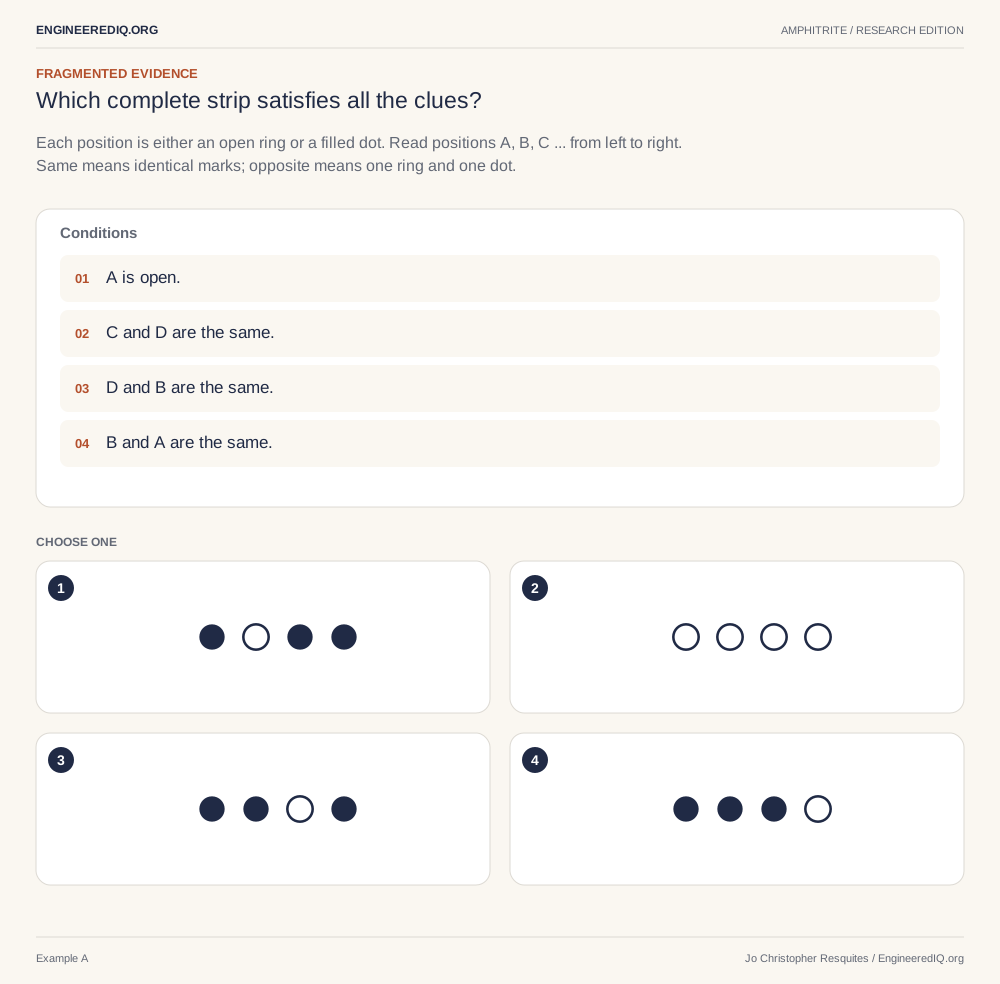
Fragmented evidenceWhich complete strip satisfies all the clues?
Show the answer
Answer 2. A is open. Following the clues from there: B is the same as A, so open; D is the same as B, so open; C is the same as D, so open. The only strip that satisfies them all is open, open, open, open.
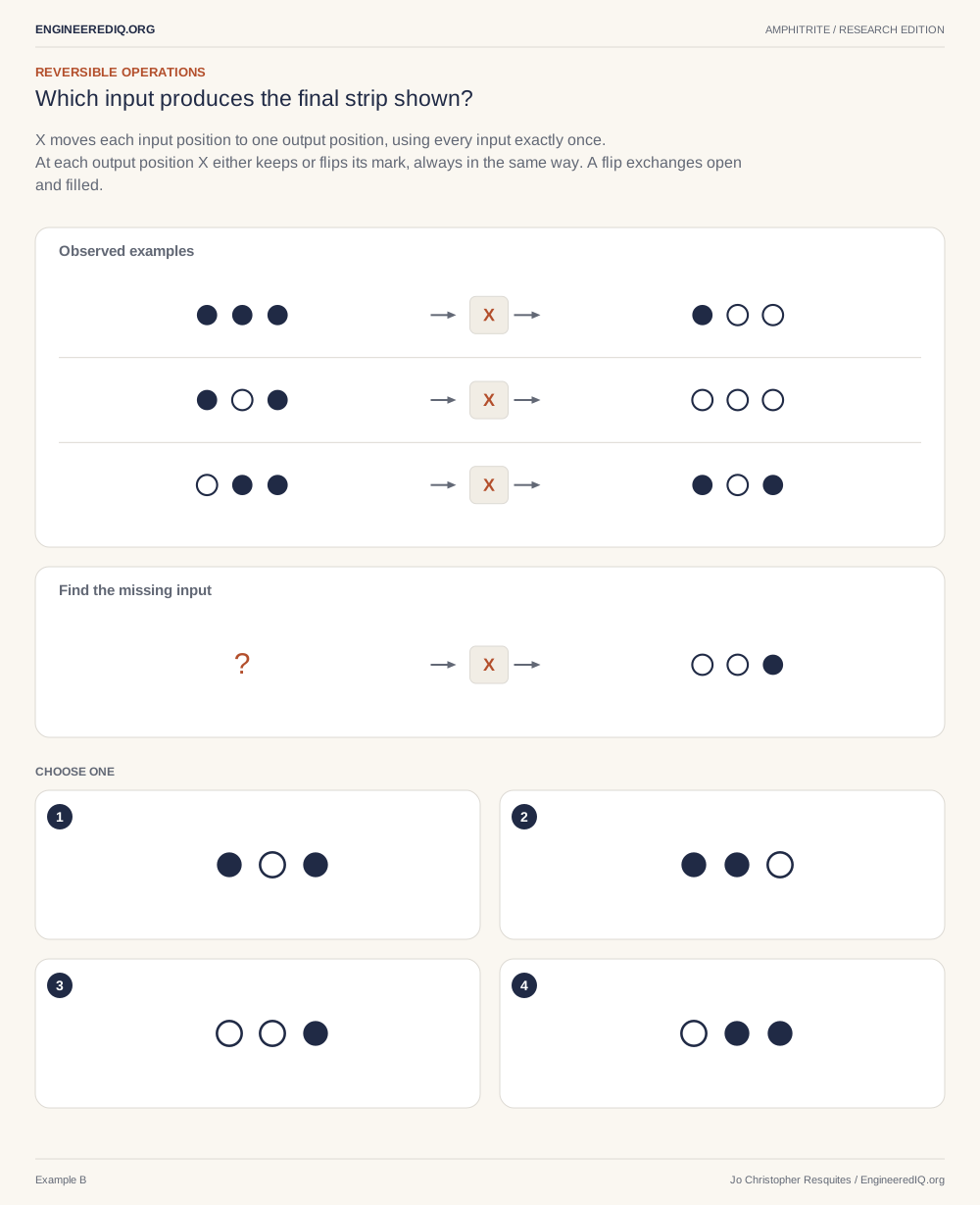
Reversible operationsWhich input produces the final strip shown?
Show the answer
Answer 3. From the examples, X sends input 2 to output 1, input 3 to output 2 (flipped) and input 1 to output 3 (flipped). Undoing X once from the final strip gives open, open, filled: that is the input.
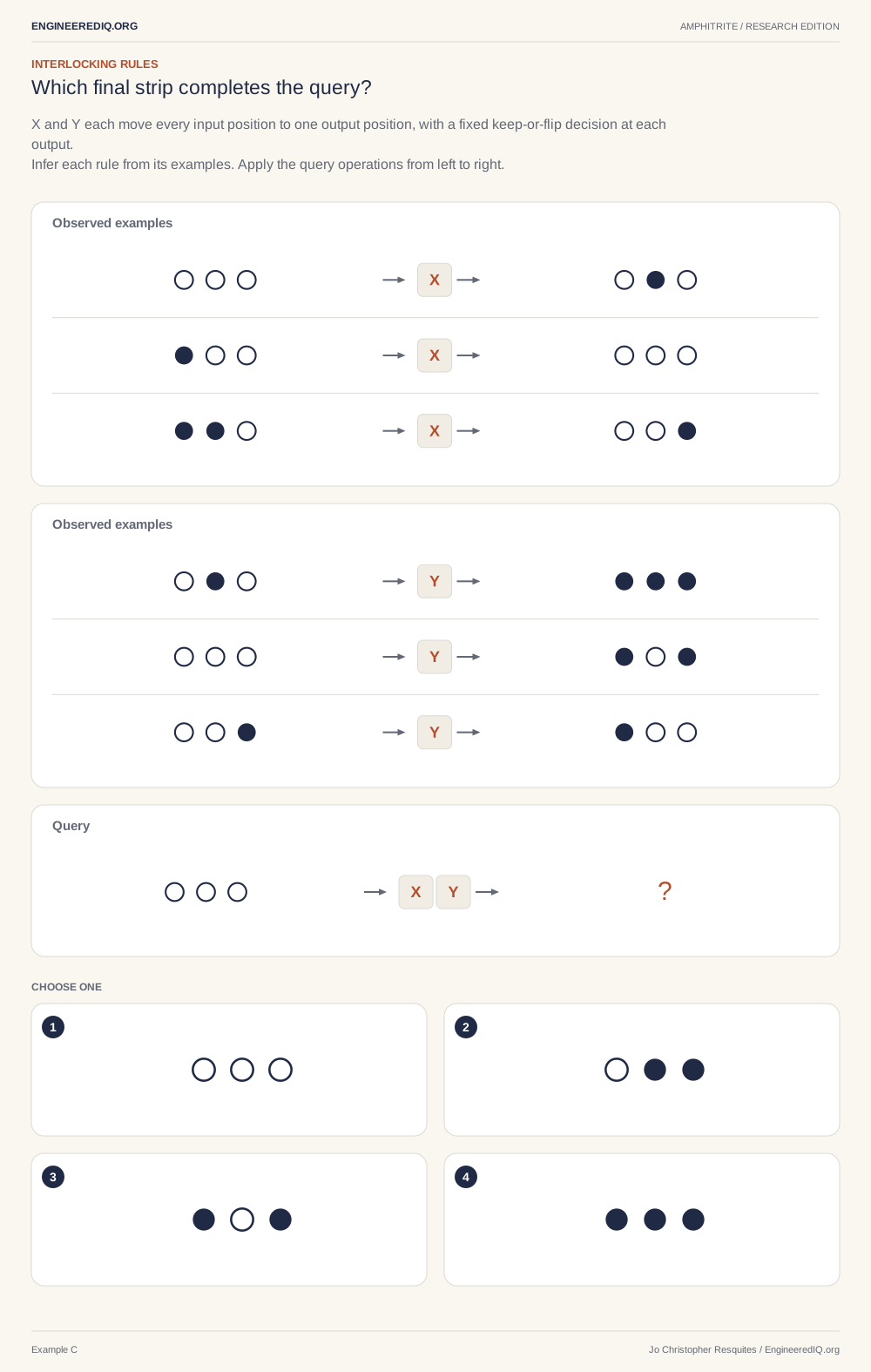
Interlocking rulesWhich final strip completes the query?
Show the answer
Answer 4. From the examples, X sends input 3 to output 1, input 1 to output 2 (flipped) and input 2 to output 3; Y sends input 1 to output 1 (flipped), input 2 to output 2 and input 3 to output 3 (flipped). Applying X then Y to open, open, open: X gives open, filled, open; Y gives filled, filled, filled.
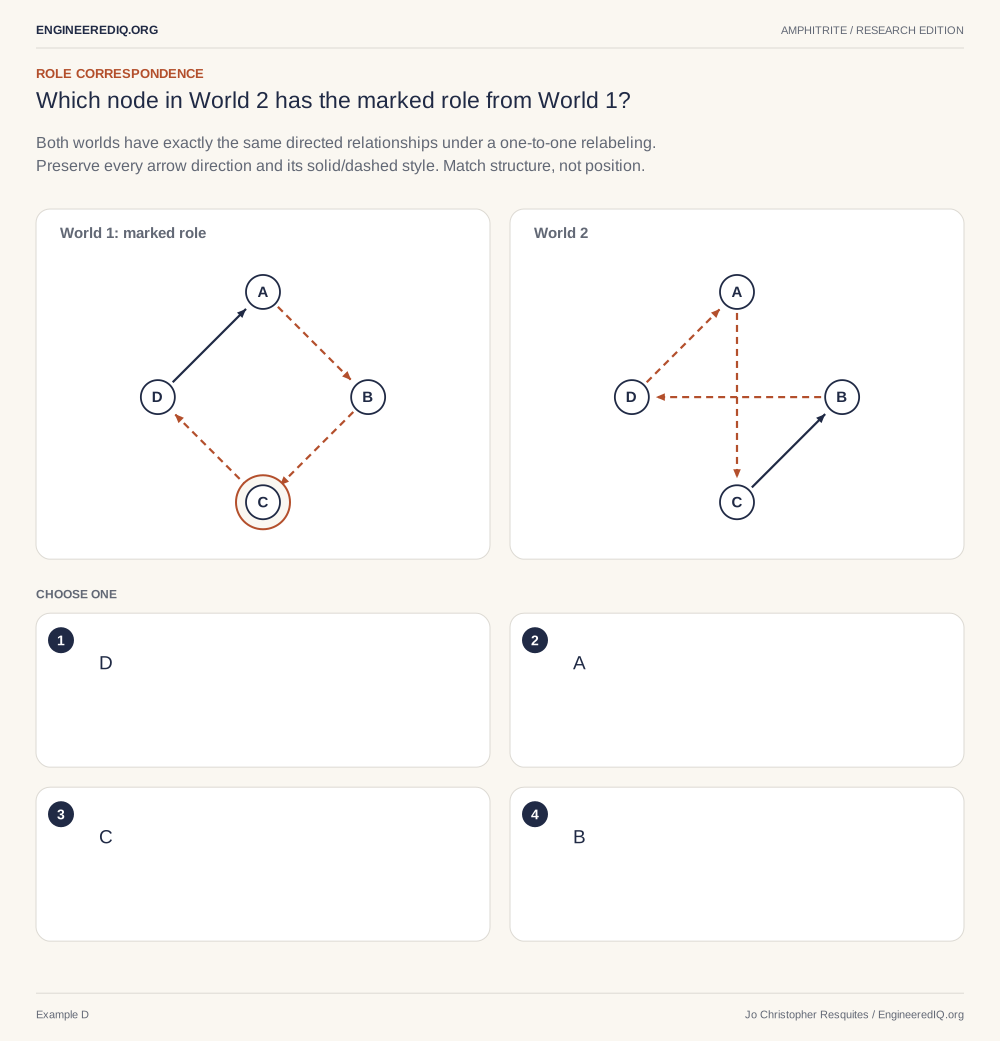
Role correspondenceWhich node in World 2 has the marked role from World 1?
Show the answer
Answer 2. The marked node C has one dashed arrow leaving it and one dashed arrow arriving. In World 2, A and D have the same arrows, but only A also has matching neighbors: every relabeling that keeps all the arrows, their direction and style sends the marked node to A.
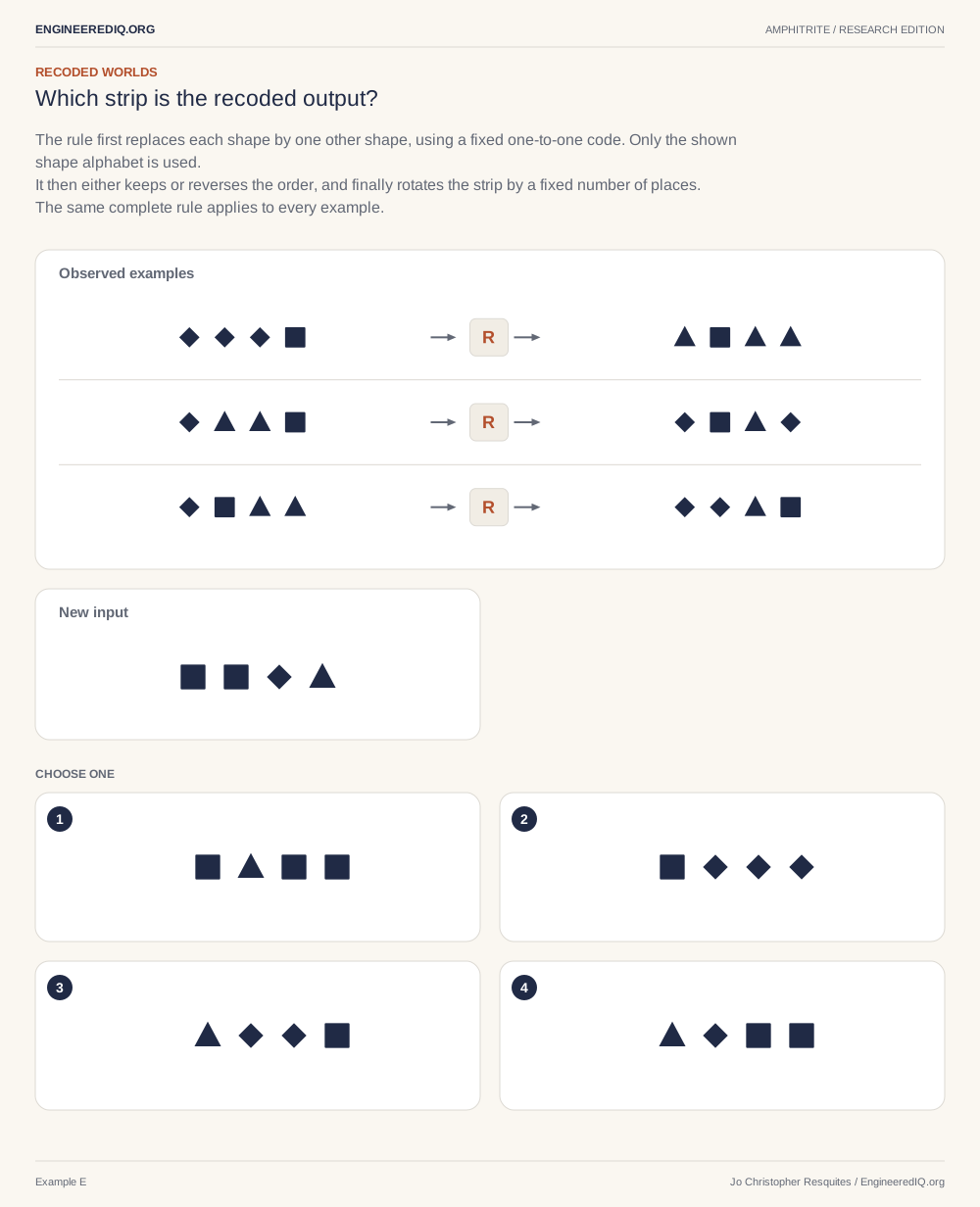
Recoded worldsWhich strip is the recoded output?
Show the answer
Answer 4. From the examples, the code turns diamond into triangle and triangle into diamond, and keeps square. Then the order is kept and the strip turns 2 places to the left. Applied to square, square, diamond, triangle, this gives triangle, diamond, square, square.
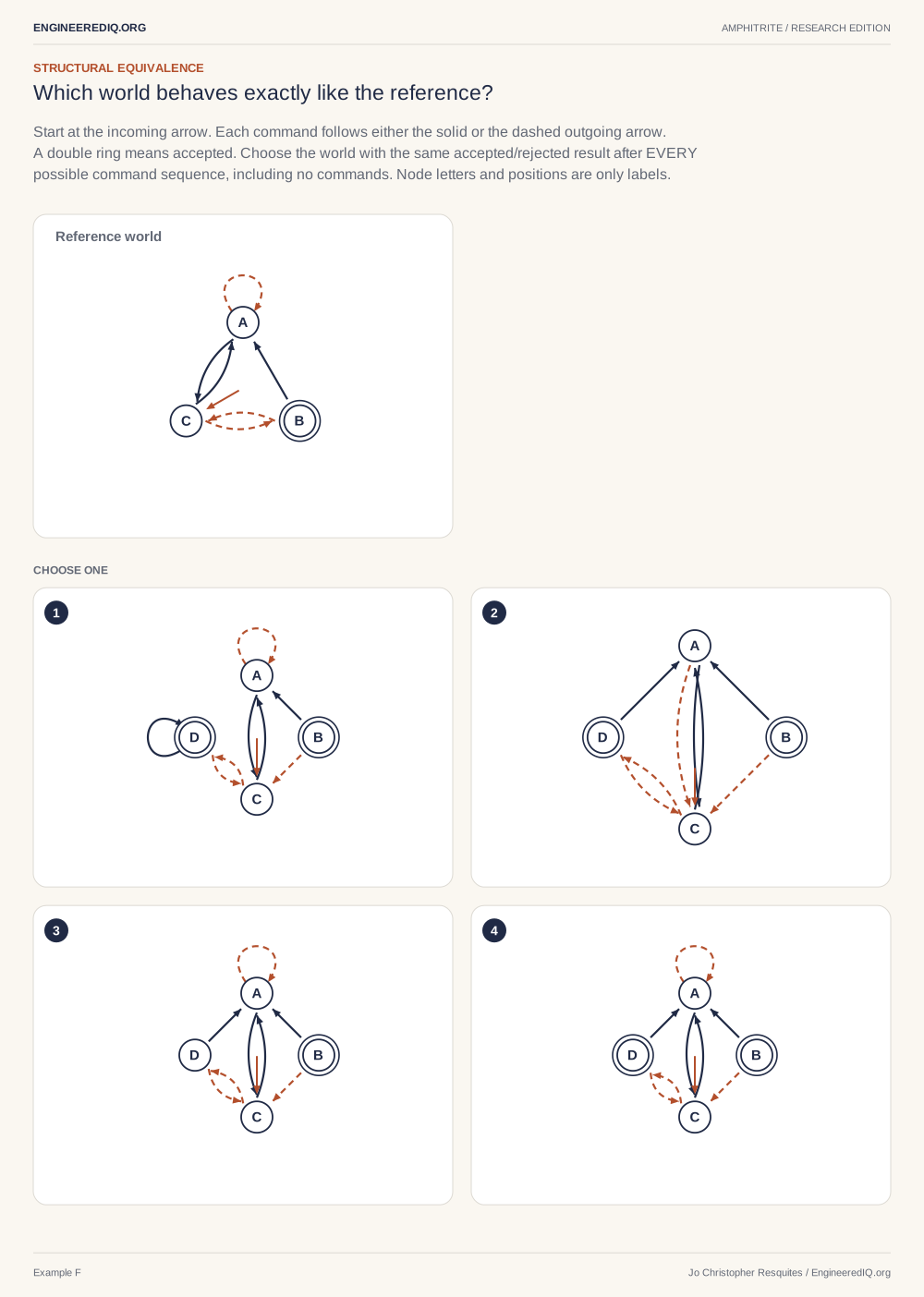
Structural equivalenceWhich world behaves exactly like the reference?
Show the answer
Answer 4. Run each world side by side with the reference under the same commands. Option 4 gives the same accepted or rejected result after every command sequence. Each other world differs somewhere: option 1 after dashed, solid (it accepts, the reference does not); option 2 after solid, dashed, dashed (it accepts, the reference does not); option 3 after dashed (the reference accepts, it does not).
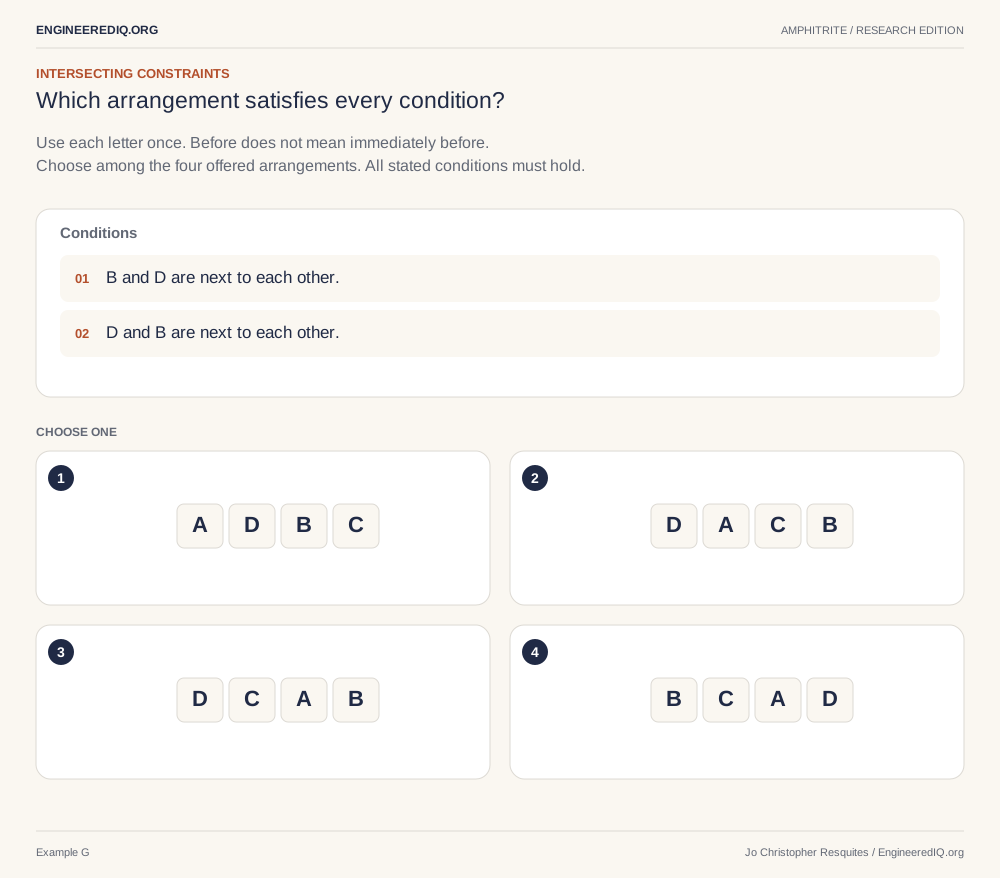
Intersecting constraintsWhich arrangement satisfies every condition?
Show the answer
Answer 1. Only option 1 (A, D, B, C) meets every condition. Options 2, 3 and 4 break “B and D are next to each other”.
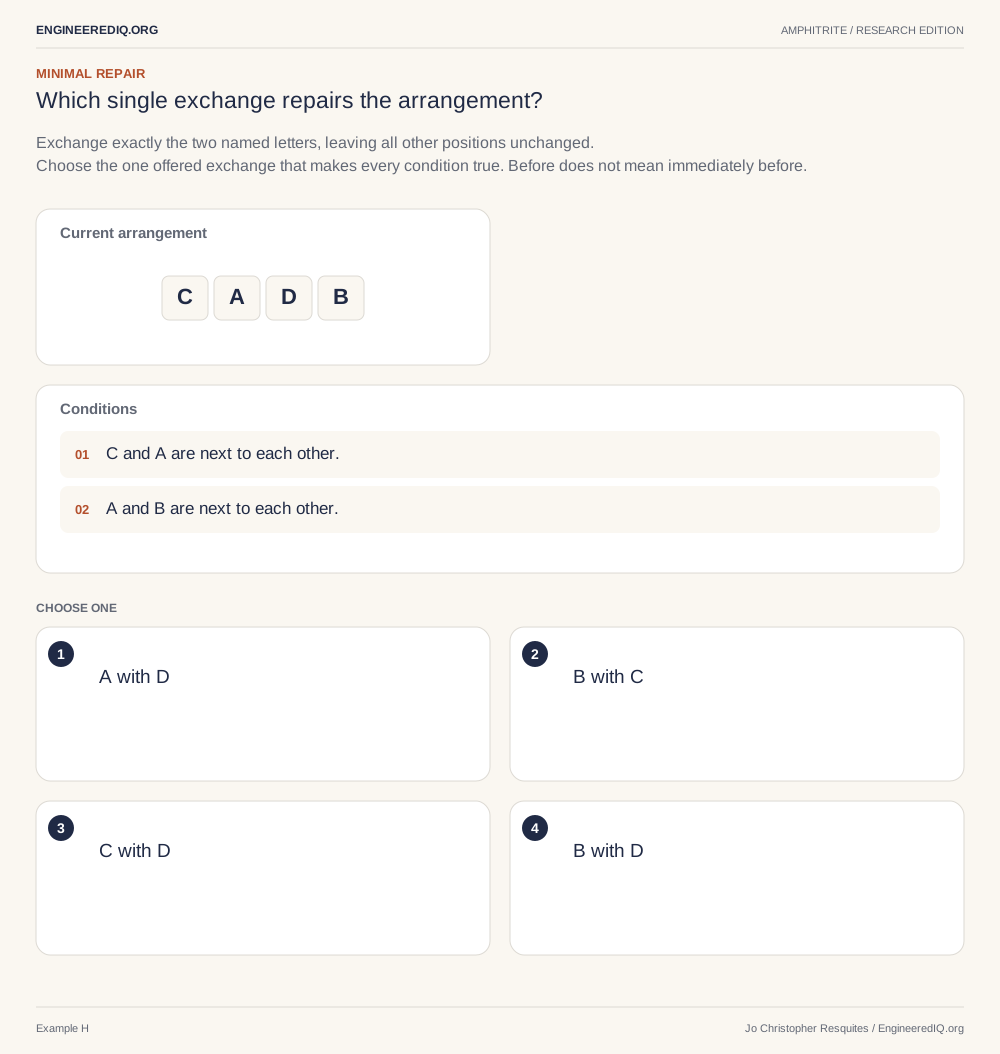
Minimal repairWhich single exchange repairs the arrangement?
Show the answer
Answer 4. Exchanging B and D turns C, A, D, B into C, A, B, D, which meets every condition. Each other exchange fails: exchanging A with D leaves “C and A are next to each other” broken; exchanging B with C leaves “C and A are next to each other” broken; exchanging C with D leaves “A and B are next to each other” broken.
Nested conditionsWhich board satisfies all conditions?
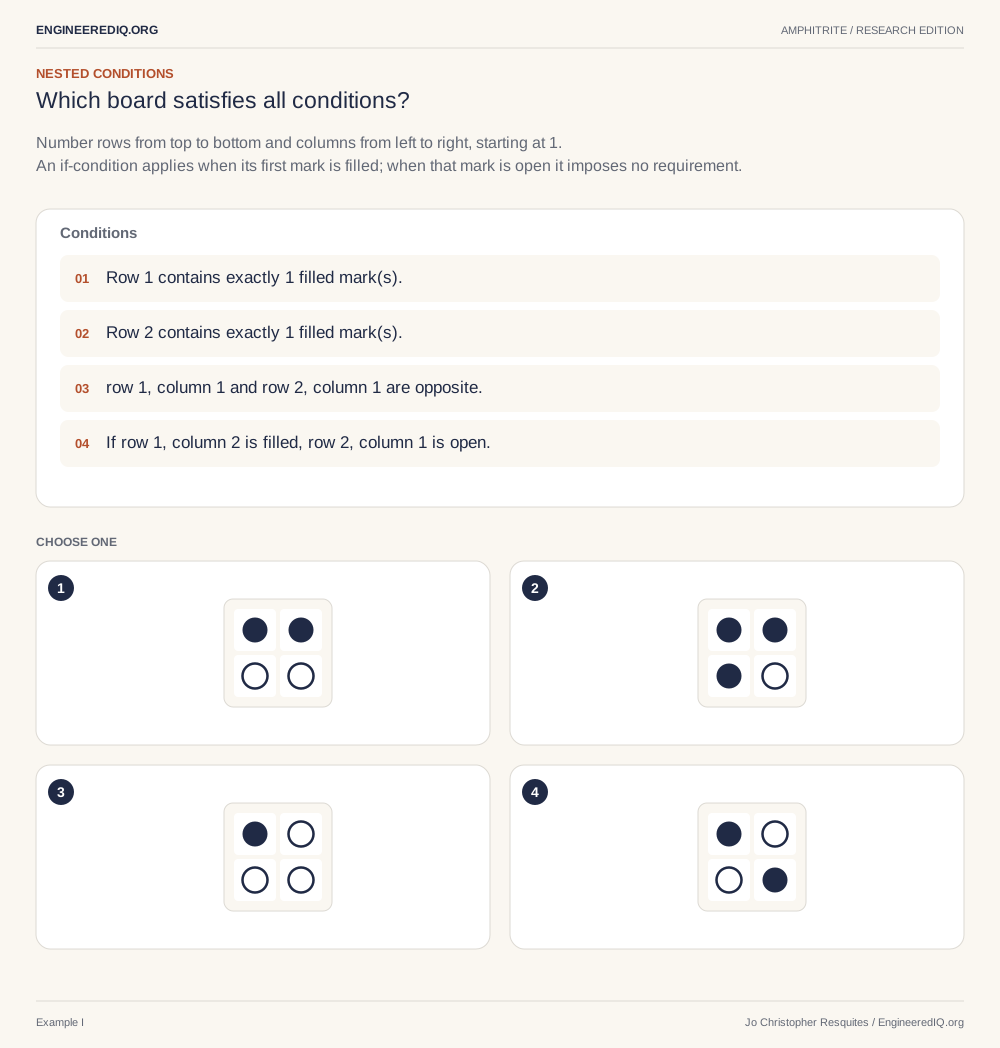
Show the answer
Answer 4. Only option 4 meets every condition. Options 1 and 2 break “Row 1 contains exactly 1 filled mark(s)”; option 3 breaks “Row 2 contains exactly 1 filled mark(s)”.
Counterfactual outcomesAfter the intervention, which two final outputs result?
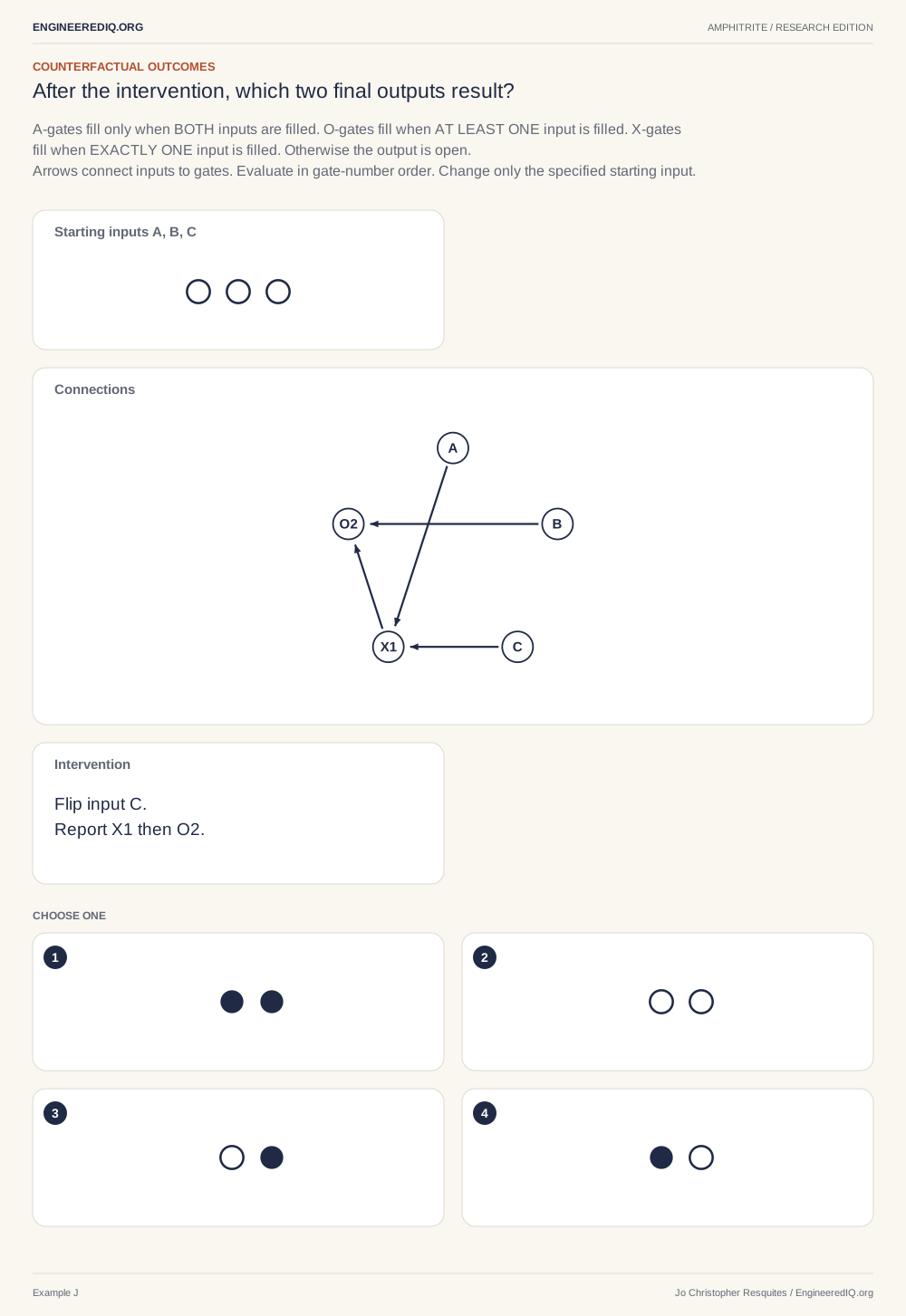
Show the answer
Answer 1. Flip C: the inputs become open, open, filled. Then, in gate order: X1 (exactly one of C and A) is filled; O2 (at least one of X1 and B) is filled. So X1 is filled and O2 is filled.
Preserved relationshipsWhich offered pair ALWAYS has matching marks?
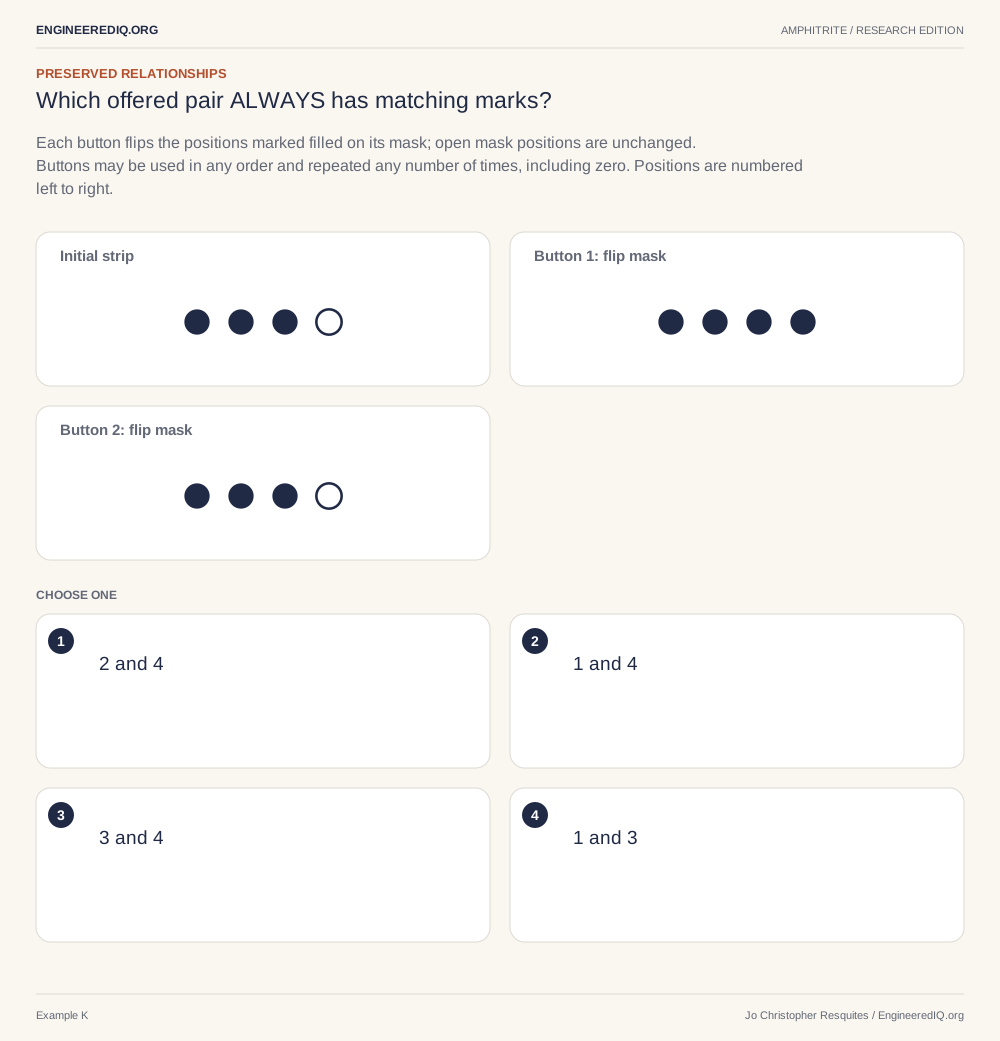
Show the answer
Answer 4. Positions 1 and 3 start with matching marks (filled), and every button flips both of them, so they always match. Each other pair can come apart: positions 2 and 4 start different; positions 1 and 4 start different; positions 3 and 4 start different.
Decisive evidenceWhich input is a decisive test of the hidden rule?
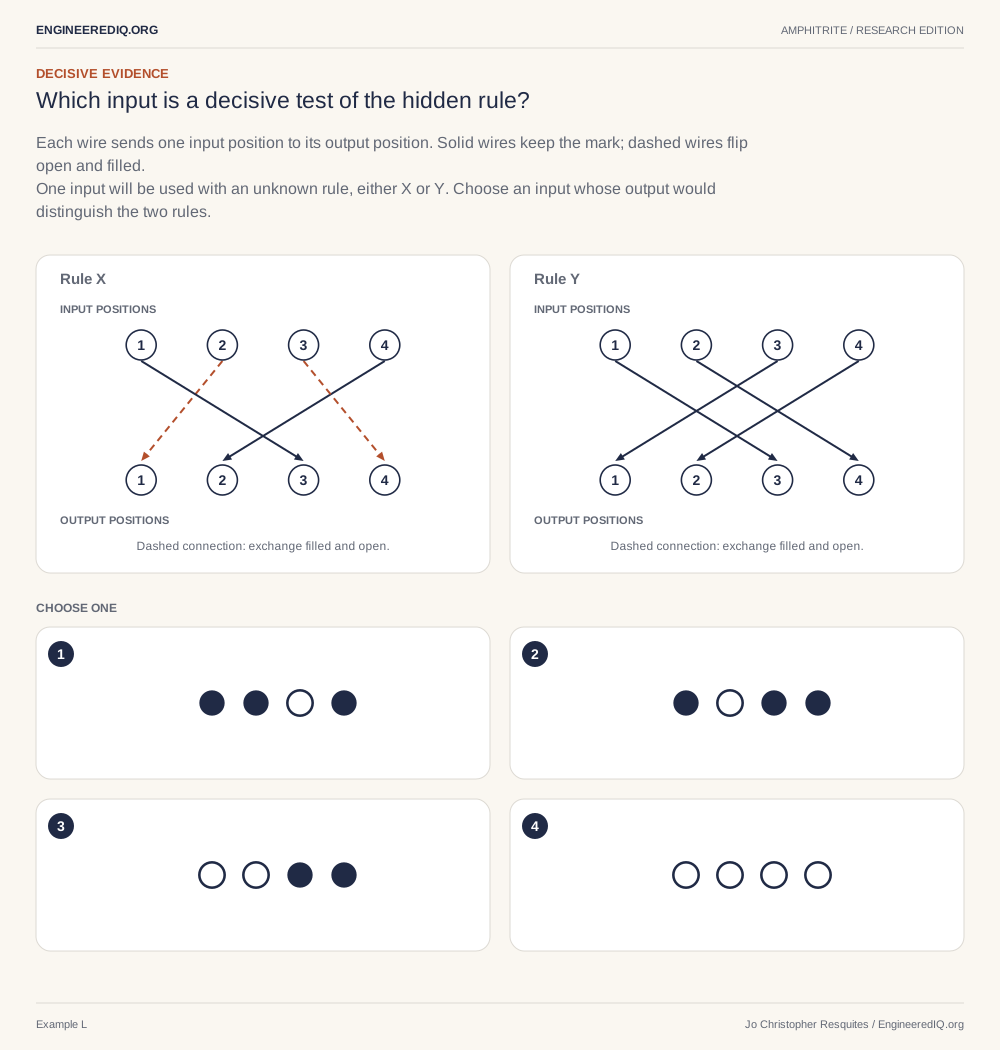
Show the answer
Answer 4. Work out both outputs for each offered input. With open, open, open, open (option 4), rule X gives filled, open, open, filled and rule Y gives open, open, open, open: they differ, so the output shows which rule is in use. Every other input gives the same output under both rules, so it decides nothing.
Built to keep outside help out
- Keys on the server. The answer keys never reach your browser, and the result never shows which problems you solved. Only the problem on screen ever reaches your browser, and the next one is chosen on the server after you lock your answer.
- Never the same problem twice. Every attempt draws from a bank of 18,196 problems. A problem counts as seen the moment it reaches your screen, with every variant built on the same rule, and no later attempt of yours meets it again.
- Watermarked problems. Every problem is drawn on the screen with a faint watermark of your name and certificate ID.
- Recorded. Leaving the test window, screenshot shortcuts (Print Screen, Windows+Shift+S, Command+Shift+3, 4 or 5), printing (Ctrl+P or Command+P), copy, right-click and drag attempts, paste attempts (pasting is switched off) and AI assistant add-ons in the page are recorded problem by problem, with the server's own times. Printing shows blank pages.
- Checked. The server keeps its own time for each problem, from showing to locking, and notes right answers given moments after a long absence from the test, and many right answers in a few seconds. As on THETIS, it also checks the answer pattern against the difficulty of the problems you were given: one that is unlikely for a single person at your level is noted, as is a result at the top of the scale. Unusual results are reviewed, never judged automatically.
- Sealed and reported. The record is sealed when you finish; its fingerprint is printed on your certificate, so it cannot be changed afterwards. The author's integrity report of your attempt lists all of it, problem by problem.
No untimed online test can rule out every form of help. These measures make it visible, and the author reviews every result before it counts for a society.
Your result
Your IQ is the estimate of the provisional model AM-M01 of AMPHITRITE (model-based; no norming sample yet) from the problems you were given and your answers to them, with its 95% interval. Deviation IQ, mean 100, SD 15. No percentile is reported: no norming sample has been tested yet, so a score is a position on the test's own scale, which reaches IQ 225+ as a research range. Beside it, as on THETIS, the rule complexity: the construction level (1 to 8) of the problems you solve half the time beyond chance.
Societies. IQ 147 or higher meets the criterion of the Nereid Society, IQ 160 that of the Mesopelagic Society (with a one-time membership fee), and IQ 190, 205 and 220 those of the Aphotic, Hadal and Exocosm Societies. Just below the criteria, IQ 135 to 146 qualifies for associate membership of the Nereid Society and IQ 180 to 189 for subscription to the Aphotic Society, each with a one-time admission fee. Your best result counts, as AMPHITRITE's ladder holds it (from 5 November 2026).
Take AMPHITRITE online
Use a screen large enough to read the arrows and labels: a computer or tablet is best. A phone works too (zoom in on the problem). Keep scratch paper ready.
Loading your test…
AMPHITRITE online is not accepting new candidates at the moment
Please check back soon, or take THETIS, the adaptive online test, today.
Your details
Already paid? Recover my test
Payment
- AMPHITRITE: one untimed attempt, its scoring and certificateUS$19.99
- Name on certificate
PayPal processes the payment; you can pay with a PayPal account or a debit or credit card. Your test is ready the moment the payment completes, and you can begin at once or later.
Have a code?
Your test is ready,
- Untimed. Once you begin, your test stays open for 90 days. Work in as many sittings as you like; your private link reopens it on any device.
- Practice first: 12 problems, one per family. Lock each answer to see whether it was right, the right answer and the reasoning. Practice is never scored.
- Then the scored problems come one at a time, each chosen from your answers so far: forty of them, more demanding as you succeed. Choose 1 to 4 and lock your answer; the next problem appears.
- A locked answer is final. It cannot be changed, and you cannot go back.
- Your result comes from the problems you were given and your answers to them. Nothing tells you whether a scored answer is right, and the result never shows which problems you solved.
- Work alone, with scratch paper only. Leaving the test window, screenshot shortcuts, printing, and copy or paste attempts are recorded with your result for the author's review.
Camera check (required)
While a problem is on screen, this page watches your camera for a phone, another person or an empty seat. The check runs in your own browser: the video never leaves your device. When it sees one of these, it keeps a small still picture for the author's review, deleted after 90 days. It never changes your score, and your certificate's verification page shows that it covered your whole test.
- Sit facing the camera in good light, with your face in view.
- Keep your phone and other devices out of reach, and work alone.
- If the camera stops, the problem is covered until it is back. Breaks are fine: close the page or step away between problems.
How to read the problems
Every problem states its rules
Each problem opens with its question and the rules of its family. Read them in full: every condition is exact, and the rules of one problem never carry over to the next.
Four choices, one valid
Exactly one of the four offered choices is valid under the problem's rules. When a problem asks you to choose among the offered arrangements, boards or exchanges, other solutions that are not offered do not count: choose among the four.
Marks and lines
An open ring and a filled dot are the two marks of a strip. Solid and dashed lines are different relationships, and an arrowhead gives a direction. Color never carries information on its own.
Letters and positions
Letters name positions or nodes within one problem only, and positions are read from left to right unless the problem says otherwise. Where a problem numbers positions, the first is 1.
Practice complete
Now the scored problems
You have seen how every family works. From here on, your answers count.
- The scored problems come one at a time, each chosen from your answers so far, forty in all.
- Nothing tells you whether a scored answer is right. Your result appears the moment the last answer is locked.
- A locked answer is final: you cannot change it or go back. Answer every problem: a guess is better than none.
- Untimed: take a break whenever you like; your private link brings you back to this point.
Practice, not scored. Lock your answer to see the right one and the reasoning.
Your answer
Choose 1, 2, 3 or 4 (the number keys work too), then lock it. A locked answer cannot be changed.
Your AMPHITRITE result
- Right answers
- 95% interval
- Rule complexity
Your certificate
Certificate ID . Anyone can check it at .
Record fingerprint : the server sealed your answers and what this page recorded when you submitted. The same fingerprint is on your certificate, so the record can never be changed without the change showing.
How was AMPHITRITE?
Next: apply to the five societies with this certificate if it meets a criterion, take THETIS for a second, independent measure, or try DYNAMENE, the relational worlds test.
What examinees say
Comments from people who took AMPHITRITE, quoted with their permission.
AMPHITRITE: questions
What is AMPHITRITE?
An untimed, adaptive online test of fluid reasoning, from the AMPHITRITE research edition A03 (28 October 2026), for ages 16 to 80. Its twelve families of visual problems ask you to combine scattered clues, undo hidden operations, compose two rules, match roles across worlds, decode recoded strips, compare worlds of commands, satisfy constraints, repair an arrangement, read nested conditions, follow an intervention through gates, find what never changes and choose the decisive evidence. Every problem has four choices, and an independent computer check confirmed that exactly one of them is valid under the problem's rules for every problem in the bank: the 2,400 practice problems and the 18,196 scored problems that can be given.
How does an attempt work?
It opens with 12 practice problems, one per family. Answer each and lock it: you see at once whether you were right, the right answer and the reasoning. Practice is never scored. Then the scored problems come one at a time, each chosen from your answers so far: the model picks, among the families you have met least, the problem that tells most about your level, for 40 scored problems; from level 5 up, a level opens only once you have solved the one below it consistently. Choose one of the four answers, numbered 1 to 4, and lock it; a locked answer cannot be changed, and you cannot go back. Every scored problem must be answered: a guess is better than none. Nothing tells you whether a scored answer is right, and your result appears the moment the last one is locked.
How hard are the levels?
Every family has eight construction levels, with model difficulties of IQ 55, 75, 90, 105, 125, 150, 185 and 225 from level 1 to level 8. Edition A03 (28 October 2026) rebuilt the two top levels of every family, and every level of Recoded worlds and Decisive evidence, so that the construction itself grows with the level. A problem at level 7 or 8 cannot be solved by following its clues one at a time: it needs a hypothesis tested against the conditions, several conditions combined that settle nothing alone, or a structure followed several steps deep. Its wrong choices are near misses built to survive a quick check: each breaks only one condition, follows from a single slip, or agrees with the right answer on everything a glance can check. The IQ values of the levels are still the model's assumptions: they become measured difficulties only once real first attempts are analyzed.
How is my score worked out?
From the problems you were given and your answers to them, by the provisional model AM-M01: each problem has an assumed difficulty from its family and level, and the model's estimate of your ability is shown as an IQ (mean 100, SD 15) with its 95% interval. Two people with the same number of right answers can receive different problems and different results. AMPHITRITE is a research edition: no human calibration has been done yet (N = 0), so a score is a provisional position on the model's scale, not a percentile of the population, and no percentile is reported. The scale reaches IQ 225+, a research target rather than an established ceiling; above about IQ 195 a score ranks performance on this test only. An estimate below IQ 55, the level of the easiest problems, is reported as below IQ 55. Beside the IQ, as THETIS does, your result gives the rule complexity: the construction level, from 1 to 8, of the problems you solve half the time beyond chance. It describes what you solved, so it depends on no population norm.
A high score must rest on consistent success at the levels below it (the ladder, from 5 November 2026, as THETIS has above IQ 180). From level 5 up, AMPHITRITE climbs one level at a time: no problem above the level being cleared is given until it is solved consistently, which takes at least three right answers at that level, from at least two families, with at least two in three of its problems right; very consistently, from 160 up, at least four right, with at least three in four of its problems right. So a score of 135 or more needs level 5 (problems of IQ 125) solved consistently, 150 or more level 6 (IQ 150), 160 or more level 6 solved very consistently, 190 or more level 7 (IQ 185) very consistently and 225+ level 8 (IQ 225) very consistently. Until then a score is held just below the next step, however well the answers above it went; the result and the certificate say so.
How long do I have, and can I take breaks?
AMPHITRITE is untimed. From the moment you begin, your attempt stays open for 90 days: work in as many sittings as you like, on any device, with your private link, and you come back to the problem you left. Each answer is locked on the server as you give it. An attempt still open after 90 days is scored with the answers locked by then, provided it has at least 24 scored answers; otherwise it ends without an IQ.
Can I take it more than once?
Yes, whenever you like once your previous attempt is finished, and every attempt is on problems you have never been shown. Every problem counts as seen the moment it reaches your screen, together with every variant built on the same rule, under this email or another registered with the same name and year of birth; no later attempt meets it again. Practice gets new problems too, while they last. Every attempt has its own fee and its own certificate. Register every attempt with the same email. Only first attempts go into the research data on the test's norms.
What does the fee cover?
The US$19.99 fee, paid through PayPal before the attempt opens, covers one attempt: the practice problems with their explanations, the 40 scored problems, your result with its PDF certificate, and a copy by email. Each retake has its own fee.
Does an AMPHITRITE result count for the societies?
Yes, from 5 November 2026. IQ 147 or higher meets the criterion of the Nereid Society, IQ 160 that of the Mesopelagic Society (with a one-time membership fee), and IQ 190, 205 and 220 those of the Aphotic, Hadal and Exocosm Societies. Just below the criteria, IQ 135 to 146 qualifies for associate membership of the Nereid Society and IQ 180 to 189 for subscription to the Aphotic Society, each with a one-time admission fee. Your fee includes the review of one society application. Your best result counts, as for THETIS, and it counts as AMPHITRITE's ladder holds it: a high score must rest on consistent success at the levels below it (see “How is my score worked out?”). AMPHITRITE is a research edition, scored with provisional model norms until enough first attempts are in, and the author reviews every result before admission.
Why does the registration ask about an earlier supervised test?
To build AMPHITRITE's norms from real people. They are re-estimated from first attempts only, anchored on examinees whose IQ is known from a supervised test, such as a Wechsler or Stanford-Binet scale given by a psychologist, Raven's or Cattell's test given under supervision, or a high-IQ society's supervised admission test. Giving yours is optional, and it never changes your own result: it only helps place the problems on the IQ scale for everyone. Only attempts with a clean integrity record are used, and a new calibration is applied only when, checked on people it was not fitted on, it comes closer to their known IQs than the scale in force. If you allow it, the author may write to you to confirm the score.
How does the online test keep AI and other help out?
The answer keys and the bank never leave the server, and your result never shows which scored problems you solved. Only the problem on screen ever reaches your browser: the next one is chosen on the server after you lock your answer, from the answers you gave, so there is no list of problems to look up in advance, and a retake is always on problems you have never been shown. Each problem is drawn on the screen with a faint watermark of your name and certificate ID. While a problem is on screen, the test page records leaving the test window, screenshot shortcuts (Print Screen, Windows+Shift+S, Command+Shift+3, 4 or 5), printing (Ctrl+P or Command+P), copy, right-click and drag attempts, and AI assistant add-ons that insert themselves into the page; the server keeps its own times (when each problem was shown and when its answer was locked) and notes right answers given moments after a long absence, and many right answers in a few seconds. As on THETIS, it checks the answer pattern against the difficulty of the problems you were given (a pattern unlikely for one person at your level is noted, as is a result at the top of the scale), and practice problems are recorded too. The record is sealed when you finish, and its fingerprint is printed on your certificate. The author's integrity report of each attempt lists all of it, problem by problem. None of this changes a score, and unusual results are reviewed, never judged automatically. An untimed test cannot rule out every form of help, which is why you declare that you will work alone.
What if I lose my link or change devices?
Your private link (shown when your test is ready, and kept in this browser) reopens your test on any device, at the problem you have reached. If you lose it, use “Recover my test” with the PayPal Transaction ID from your receipt and the email you registered with. Every locked answer is on the server.
Can I see example problems first?
Yes: the twelve example problems above, one per family, with their answers and solutions. They are never used in the test itself, nor is any variant built on the same rule.
Rules, fee and privacy
Test rules
Work on AMPHITRITE alone, with scratch paper only: no person, AI system, search engine, calculator, program, published solution or other aid. Do not copy, photograph, record or share the problems or your answers. Each person may take AMPHITRITE again whenever they like once the previous attempt is finished, always registered with the same email: each attempt is on problems the person has never been shown and has its own fee and certificate. One attempt is open at a time, and a locked answer cannot be changed, and a test belongs to the person registered for it. You may take as many breaks as you like within the 90 days. Results that show signs of outside help may be withheld from society admission or withdrawn.
Fee and refunds
The fee is US$19.99 for each attempt, paid through PayPal (PayPal account or card) before the attempt opens. It covers the online administration of one attempt, its practice problems with their explanations, scoring, and your result and certificate. Because the problems are shown as soon as a test begins, a test that has begun cannot be refunded. If a payment went through but the test did not open, use “Recover my test”, or write to jresquites@mensaphilippines.org with your PayPal Transaction ID.
Privacy notice
Your name, email, year of birth, country and earlier scores are used to run your test, to issue and verify your certificate, to build the norms and, with your consent, in de-identified research summaries. An earlier supervised score you give is used only to re-estimate the test's norms, and the author writes to you about it only if you allow it. Your answers, the times the server kept and the integrity record (departures from the test window, screenshot shortcuts, copy, paste or print attempts, and the names of AI assistant add-ons found in the page; other add-ons are never recorded) are kept with your result for scoring, norm updates and the review of society applications. The camera check, which every test requires, runs in your own browser: the video from your camera is analyzed on your device and is never sent or stored. When it sees a phone, another person or an empty seat while a problem is on screen, the page sends one small still picture (160 by 120 pixels) with its time, kept for the author's review and deleted 90 days after it was taken; its summary of each problem (how long it watched, and when it saw any of these) is kept with your integrity record. The detector's program and model load from public servers (jsDelivr and Google), which see your device's address as any website does. How you reached the site (the name of the site or app that linked to it, or the tag in the link you followed, which your browser keeps for 30 days) is recorded with your payment, without your name, to count which channels bring candidates. When your test ends, your result, the private link to it and the link to your certificate are emailed to you (through Resend, an email service). Your email is never shown publicly, and you can hide your name on the public verification page at any time. Data are stored by Netlify and Redis Cloud and are never sold.