
World I · problems 1–6
Mutable Matrices
Rows of lattice panels made by hidden laws that may change between rows.
An extreme-range test of fluid reasoning · Form A
The Abductive–Dynamic Reasoning Test
In the oldest tales, Proteus answered only those who kept hold of him through every change of shape. PROTEUS asks for that grip. You infer a hidden law from too little evidence, notice when it silently changes, let the old law go, find its successor, and carry it into a new material. It was built to be one of the hardest IQ tests you can take.
Abductive–dynamic reasoning, also called rule plasticity: finding the best explanation of new, incomplete or changing evidence, and revising it when the evidence turns. Every problem asks for several of these six acts.
Problems rise in difficulty within each world. The Frontier, the last world, was built for the farthest reaches of the range.
World I · problems 1–6
Rows of lattice panels made by hidden laws that may change between rows.
World II · problems 7–12
Strips and necklaces that move, grow and transform, sometimes by more than one law.
World III · problems 13–18
An oracle sorts cards by a law it never states, and the law may change.
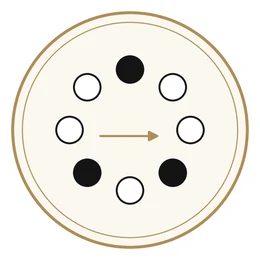
World IV · problems 19–24
Two machines obey one law in different materials. Learn it in one, predict the other.
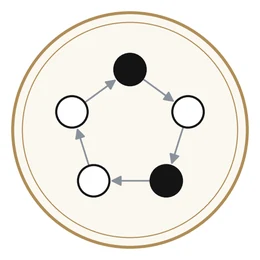
World V · problems 25–30
Boards of lamps wired by unseen laws. Reason about causes, interventions and what might have been.
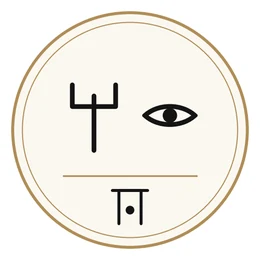
World VI · problems 31–40
Ten artifacts from stranger worlds: hidden lamps, damaged records, alien life, migrating grammars.
Download and work on PROTEUS at no cost. A scoring fee of US$30 applies only when you submit your answers for an official score, and your report arrives within 14 days. Print the booklet or read it here, and record your answers on the Answer Sheet at the back.
Version 1.1 (October 2026): all 40 problems, the rules and the Answer Sheet. PDF, 55 pages, 4.4 MB.
Download the bookletThe five answer pages with the declaration, ready to print. PDF, 5 pages.
Download the answer sheetEvery page of the booklet, here on the site. Type your answers in the answer helper when you are ready.
Open the readerForm B is the retest form: 40 new problems on the same blueprint and the same scale. It is not published online. It is emailed on request to candidates whose Form A answer sheet was scored at least six months earlier, and its score is reported separately, never averaged with Form A.
Use the arrows or the list to move through the booklet. Zoom in for the finest figures.
The Principle of the Best Explanation
Many accounts may fit part of the evidence. The intended answer follows from the simplest account that fits all of it, judged in this order:
A regularity that governs when or how a law changes counts as one law. Every problem was checked by a computer program that enumerated its rival explanations, from a few hundred to nearly a trillion, and confirmed that the simplest ones all lead to the same answer.
Your raw score (0–40) becomes a deviation IQ (σ = 15) reported with a 90% interval. These are the provisional norms (v1.0) of the PROTEUS Technical Manual and will be replaced by empirical norms as attempts accumulate. Form B has its own norm table on the same scale.
All four figures are model-based projections from the PROTEUS Technical Manual. No examinee data existed when they were computed, so early attempts help turn them into empirical values.
| Raw score | IQ (σ 15) | 90% interval | Note |
|---|---|---|---|
| 5 | 133.5 | 124.8–142.2 | about 1 in 78 |
| 10 | 146.5 | 139.5–153.4 | about 1 in 1,000 |
| 15 | 156.4 | 149.8–162.9 | about 1 in 12,000 |
| 20 | 165.7 | 159.1–172.3 | about 1 in 170,000 |
| 25 | 176.0 | 168.7–183.3 | about 1 in 5 million |
| 30 | 189.3 | 180.5–198.2 | about 1 in 770 million |
| 35 | 213.0 | 200.3–225.8 | position on the test's own scale |
| 40 | ≥ 250 | 225.5–274.5 | nominal ceiling |
Rarities are normal-theory estimates. From raw 32 upward, a score is rarer than one person in eight billion, so it is reported as a position on the PROTEUS scale rather than as a frequency in the population.