
Adaptive online IQ test · untimed · 40 problems · ages 16 to 80
NEMERTES: the decisive experiment
In Greek myth, Nemertes is the Nereid whose name means unerring. Her test asks for the one experiment that cannot mislead you.
Every NEMERTES problem shows two machines, Left and Right. Each changes a board of pieces by a rule of its own, and a few examples show what each one does. On the start board both machines give the same result. Make one change to it, putting a piece on an empty cell or taking one away, so that the two machines give different results. Four practice problems show how it works; then forty problems come one at a time, each chosen from your answers so far.
- Untimed
- Practice first, with the reasoning
- No answers to choose from
- Instant certificate
How it works
Register and pay
Enter your name as it should appear on your certificate, and pay the US$19.99 fee through PayPal (account or card). Your attempt is ready the moment the payment completes, with problems you have never seen.
Practice first
4 practice problems, one per family, the examples shown on this page. Lock your answer and see at once whether you were right, a change that is right and the reasoning. Practice is never scored.
Problems chosen for you
Then forty scored problems, one at a time, ten for each kind of machine, each chosen from your answers so far. Make one change to the start board and lock it; a locked answer cannot be changed. Untimed, for up to 90 days, on any device.
Get your certificate
The moment the last answer is locked: your IQ on the NEMERTES model scale with its 95% interval, the rule complexity of the problems you solve, your right answers and a PDF certificate anyone can verify, with a copy by email.
What NEMERTES measures
NEMERTES measures the reasoning of an experimenter: reading a rule from a few examples, seeing exactly where two nearly identical rules part, and building the one case that tells them apart. There is nothing to choose from: you construct the answer, and every change that makes the two machines differ is right. No words, numbers or special knowledge are needed; shape, color and position carry every distinction, in colors that stay apart for every common kind of color vision.
- Family A. Change in place
- Family B. Disappear
- Family C. Move
- Family D. Copy
Retakes: whenever you like once an attempt is finished, each on scored problems you have never been shown and with its own fee (US$19.99). Scores usually rise a little with practice, so your first attempt is the fairest measure. NEMERTES is a research edition: its results will count for society admission once its norms are established, and then your best result counts.
Try the four kinds of machine
The four practice problems that open every attempt, one for each kind of machine, with a right change and its reasoning behind a click. They are never scored, so trying them here first costs you nothing.
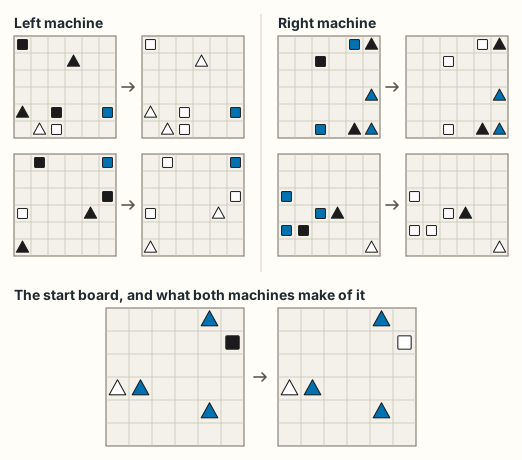
Change in placeWhich one change makes the two machines give different results?
Show the answer
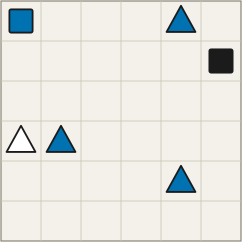
A right change: put a blue square on a1. 62 changes are right. Left: black pieces turn white, once. Right: squares turn white, once. The two rules part only where that difference matters, so the change must create such a case: for example, put a blue square on a1. 62 changes are right.
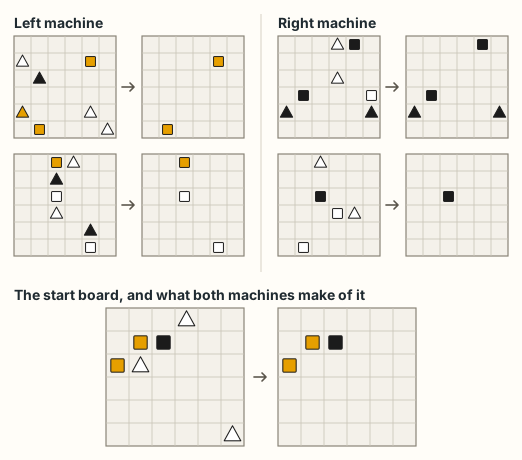
DisappearWhich one change makes the two machines give different results?
Show the answer
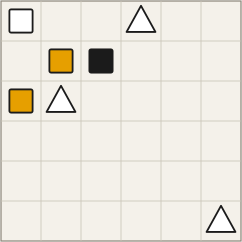
A right change: put a white square on a1. 90 changes are right. Left: triangles disappear, once. Right: white pieces disappear, once. The two rules part only where that difference matters, so the change must create such a case: for example, put a white square on a1. 90 changes are right.
MoveWhich one change makes the two machines give different results?
Show the answer
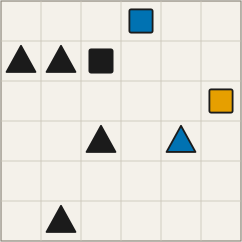
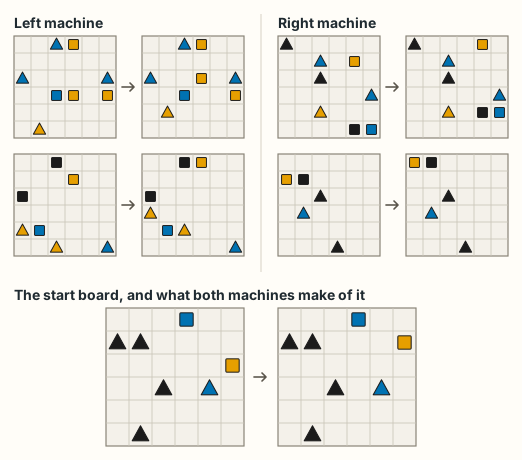
A right change: put a black square on c2. 54 changes are right. Left: orange pieces move one cell up, once. Right: squares move one cell up, once. The two rules part only where that difference matters, so the change must create such a case: for example, put a black square on c2. 54 changes are right.
CopyWhich one change makes the two machines give different results?
Show the answer
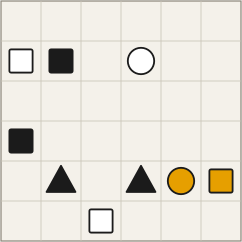
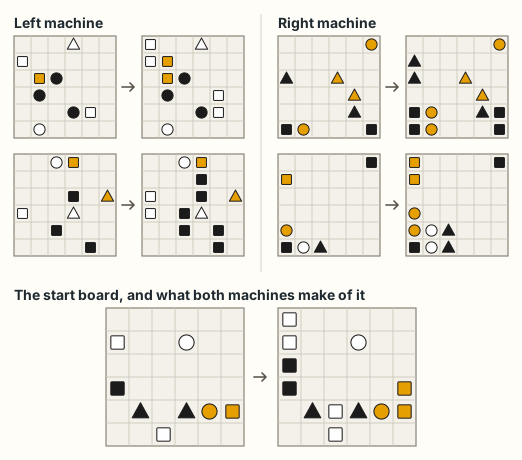
A right change: put a black square on b2. 57 changes are right. Left: squares put a copy of themselves in the cell above, once. Right: pieces on the edge put a copy of themselves in the cell above, once. The two rules part only where that difference matters, so the change must create such a case: for example, put a black square on b2. 57 changes are right.
Built to keep outside help out
- Keys on the server. The answer keys never reach your browser, and the result never shows which problems you solved. Only the problem on screen ever reaches your browser, and the next one is chosen on the server after you lock your answer.
- Never the same problem twice. Every attempt draws from a bank of 860 problems. A problem counts as seen the moment it reaches your screen, with every problem of the same two rules, and no later attempt of yours meets it again. Only the four practice problems, the examples on this page, are the same every time.
- Watermarked problems. Every problem is drawn on the screen with a faint watermark of your name and certificate ID.
- Recorded. Leaving the test window, screenshot shortcuts (Print Screen, Windows+Shift+S, Command+Shift+3, 4 or 5), printing (Ctrl+P or Command+P), copy, right-click and drag attempts, paste attempts (pasting is switched off) and AI assistant add-ons in the page are recorded problem by problem, with the server's own times. Printing shows blank pages.
- Checked. The server keeps its own time for each problem, from showing to locking, and notes right answers given moments after a long absence from the test, and many right answers in a few seconds. As on THETIS, it also checks the answer pattern against the difficulty of the problems you were given: one that is unlikely for a single person at your level is noted, as is a result at the top of the scale. Unusual results are reviewed, never judged automatically.
- Sealed and reported. The record is sealed when you finish; its fingerprint is printed on your certificate, so it cannot be changed afterwards. The author's integrity report of your attempt lists all of it, problem by problem.
No untimed online test can rule out every form of help. These measures make it visible, and the author reviews every result before it counts for a society.
Your result
Your IQ is the estimate of the provisional model NM-D04 of NEMERTES (model-based; no norming sample yet) from the problems you were given and your answers to them, with its 95% interval. Deviation IQ, mean 100, SD 15. No percentile is reported: no norming sample has been tested yet, so a score is a position on the test's own scale, which runs from IQ 70 to 184+. Beside it, as on THETIS, the rule complexity: the construction level (1 to 12) of the problems you solve half the time.
Societies. IQ 147 or higher meets the criterion of the Nereid Society and IQ 160 that of the Mesopelagic Society. Just below the criteria, IQ 135 to 146 qualifies for associate membership of the Nereid Society and IQ 184+ for subscription to the Aphotic Society. Every membership, associate members and subscribers included, has a one-time fee, with no annual dues. The criteria of the Aphotic, Hadal and Exocosm Societies lie above NEMERTES's scale, which ends at IQ 184+. Your best result counts, as NEMERTES's ladder holds it (from 5 November 2026).
Take NEMERTES online
A computer or tablet is best: the two machines' examples sit above the board you change. A phone works too: zoom in on the examples, then tap a piece in the tray and a cell of the board. Keep scratch paper ready.
Loading your test…
NEMERTES online is not accepting new candidates at the moment
Please check back soon, or take THETIS, the adaptive online test, today.
Your details
Already paid? Recover my test
Payment
- NEMERTES: one untimed attempt, its scoring and certificateUS$19.99
- Name on certificate
PayPal processes the payment; you can pay with a PayPal account or a debit or credit card. Your test is ready the moment the payment completes, and you can begin at once or later.
Have a code?
Your test is ready,
- Untimed. Once you begin, your test stays open for 90 days. Work in as many sittings as you like; your private link reopens it on any device.
- Practice first: 4 problems, one per family, the examples shown on this page. Lock each answer to see whether it was right, a change that is right and the reasoning. Practice is never scored.
- Then the scored problems come one at a time, each chosen from your answers so far: forty of them, ten for each kind of machine. Make one change to the start board and lock it; the next problem appears.
- A locked answer is final. It cannot be changed, and you cannot go back. If you cannot decide, you may leave a scored problem unanswered; it scores no point.
- Your result comes from the problems you were given and your answers to them. Nothing tells you whether a scored answer is right, and the result never shows which problems you solved.
- Work alone, with scratch paper only. Leaving the test window, screenshot shortcuts, printing, and copy or paste attempts are recorded with your result for the author's review.
Camera check (required)
While a problem is on screen, this page watches your camera for a phone, another person or an empty seat. The check runs in your own browser: the video never leaves your device. When it sees one of these, it keeps a small still picture for the author's review, deleted after 90 days. It never changes your score, and your certificate's verification page shows that it covered your whole test.
- Sit facing the camera in good light, with your face in view.
- Keep your phone and other devices out of reach, and work alone.
- If the camera stops, the problem is covered until it is back. Breaks are fine: close the page or step away between problems.
How to read the problems
The two machines
Each machine changes a board by a rule of its own: which pieces it acts on (by shape, color, position, neighbors or the whole board), what each one does (turns a color, becomes a shape, disappears, moves or copies itself), and whether it acts once or again and again until nothing changes. A few examples show each machine at work: a board before, and after.
The start board
Both machines turn the start board into the same result, shown beside it. Their rules differ in one part only, and on this board that difference does not show.
Your change
Make one change to the start board so that the two machines give different results: choose a piece in the tray and an empty cell to put it on, or choose a piece on the board to take it away. Every change that splits the machines is right; nothing shows you what they would do with it.
Cells and pieces
Cells are named by column (a, b, c and so on) and row (1 at the top). Pieces are circles, squares and triangles in black, white, blue and orange.
Practice complete
Now the scored problems
You have seen how every family works. From here on, your answers count.
- The scored problems come one at a time, each chosen from your answers so far, forty in all, ten for each kind of machine.
- Nothing tells you whether a scored answer is right. Your result appears the moment the last answer is locked.
- A locked answer is final: you cannot change it or go back. If you cannot decide, you may leave a problem unanswered; it scores no point.
- Untimed: take a break whenever you like; your private link brings you back to this point.
Practice, not scored. Lock your answer to see the right one and the reasoning.
Your change
Choose a piece in the tray, then an empty cell to put it on, or choose a piece on the board to take it away; choose the changed cell again to undo it. Then lock your change. A locked answer cannot be changed.
Your NEMERTES result
- Right answers
- 95% interval
- Rule complexity
Your certificate
Certificate ID . Anyone can check it at .
List your best verified scores in the Resquites Register, and from three tests or more get your Resquites Composite IQ.
Record fingerprint : the server sealed your answers and what this page recorded when you submitted. The same fingerprint is on your certificate, so the record can never be changed without the change showing.
How was NEMERTES?
Next: apply to the five societies with this certificate if it meets a criterion, take THETIS for a second, independent measure, or try PSAMATHE, the relational synthesis test.
What examinees say
Comments from people who took NEMERTES, quoted with their permission.
NEMERTES: questions
What is NEMERTES?
An untimed, adaptive online test of fluid reasoning, from the NEMERTES research edition NM1.0 (November 2026), for ages 16 to 80. Every problem shows two machines, Left and Right. A machine changes a board of pieces (circles, squares and triangles in black, white, blue and orange) by a rule: which pieces it acts on (by shape, color, position, neighbors or the whole board), what each does (turns a color, becomes a shape, disappears, moves or copies itself) and whether it acts once or again and again until nothing changes. The two rules differ in one part only. A few examples show what each machine does; on the start board both give the same result. You make one change to the start board, putting a piece from the tray on an empty cell or taking one away, so that the two machines give different results. There is no list of answers: every change that splits the machines is right. Every problem is built by code from a formal grammar of 41,200 rules, and an independent solver, a separate program that sees only what the problem shows, proved for every problem in the bank that every rule of the grammar fitting a machine's examples gives the same right changes, and that they are the key's. Its four families are the four kinds of machine: change in place, disappear, move and copy.
How does an attempt work?
It opens with 4 practice problems, one per family, the examples shown on this page. Answer each and lock it: you see at once whether you were right, a change that is right and the reasoning. Practice is never scored. Then the scored problems come one at a time, each chosen from your answers so far: the four kinds of machine take turns, ten problems each, and in each the model picks one of the problems that tell most about your level, for 40 scored problems; from level 8 up, a level opens only once you have solved the one below it consistently. Make your one change on the start board, a piece put on an empty cell or a piece taken away, and lock it; a locked answer cannot be changed, and you cannot go back. If you cannot decide, you may leave a scored problem unanswered: it scores no point. Nothing tells you whether a scored answer is right, and your result appears the moment the last one is locked.
How hard are the levels?
Every problem has one of twelve levels, from IQ 70 to 184, about ten points apart, computed by the model NM-D04 from how the problem is built: what it takes to read both rules, how hidden their difference is (from shape against color, at level 1, to two conditions of which one differs, applied again and again until nothing changes, from level 11), how precise the change must be (the share of all possible changes that are right, from about half at level 1 to under one in a hundred at the top), how many steps ahead the machines must be followed before they part, and how much is on the board (six by six cells, seven by seven from level 11). Every problem's difficulty lies within five points of its level's. These difficulties are the model's assumptions until real first attempts are analyzed. Four more levels, up to IQ 225, are being built: their problems take hours each to find, and they will come with a later bank.
How is my score worked out?
From the problems you were given and your answers to them, by the provisional model NM-D04: each problem is a Rasch item with its level's assumed difficulty, and the four kinds of machine take turns, ten problems each. The model's estimate of your ability is shown as an IQ (mean 100, SD 15) with its 95% interval; it uses a Jeffreys prior, which holds no score back toward the average. A problem scores its point when the change you lock makes the two machines give different results. A problem left unanswered scores no point. Two people with the same number of right answers can receive different problems and different results. In the simulation of the bank, the estimates were within about 3 to 6 IQ points of the truth from IQ 70 to 180, with a reliability of 0.89 and a retest correlation of 0.90; at IQ 190, above the hardest level released, the scale holds an estimate back by several points. NEMERTES is a research edition: no human calibration has been done yet (N = 0), so a score is a provisional position on the model's scale, not a percentile of the population, and no percentile is reported. The scale is reported up to IQ 184+, the level of the hardest problems released; an estimate below IQ 70, the level of the easiest, is reported as below IQ 70. Beside the IQ, as THETIS does, your result gives the rule complexity: the level, from 1 to 12, of the problems you solve half the time. It describes what you solved, so it depends on no population norm.
A high score must rest on consistent success at the levels below it (the ladder, from 5 November 2026, as THETIS has above IQ 180). From level 8 up, NEMERTES climbs one level at a time: no problem above the level being cleared is given until it is solved consistently, which takes at least three right answers at that level, from at least two families, with at least two in three of its problems right; very consistently, from 160 up, at least four right, with at least three in four of its problems right. So a score of 147 or more needs level 8 (problems of IQ 142) solved consistently, 160 or more level 9 (IQ 153) very consistently, 180 or more level 11 (IQ 173) very consistently and 184+ level 12 (IQ 184) very consistently. Until then a score is held just below the next step, however well the answers above it went; the result and the certificate say so.
How long do I have, and can I take breaks?
NEMERTES is untimed. From the moment you begin, your attempt stays open for 90 days: work in as many sittings as you like, on any device, with your private link, and you come back to the problem you left. Each answer is locked on the server as you give it. An attempt still open after 90 days is scored with the answers locked by then, provided it has at least 40 scored answers; otherwise it ends without an IQ.
Can I take it more than once?
Yes, whenever you like once your previous attempt is finished, and every attempt is on scored problems you have never been shown. Every problem counts as seen the moment it reaches your screen, together with every problem of the same two rules, under this email or another registered with the same name and year of birth; no later attempt meets it again. Practice is the same four problems every time: the examples shown on this page. Every attempt has its own fee. From the second attempt, the certificate is issued by the test author, who sends the one you need, as a rule that of your best result; your score is shown at once as before. Register every attempt with the same email. Only first attempts go into the research data on the test's norms.
What does the fee cover?
The US$19.99 fee, paid through PayPal before the attempt opens, covers one attempt: the practice problems with their explanations, the 40 scored problems, your result with its PDF certificate, and a copy by email. Each retake has its own fee.
Does a NEMERTES result count for the societies?
Yes, from 5 November 2026. IQ 147 or higher meets the criterion of the Nereid Society and IQ 160 that of the Mesopelagic Society. Just below the criteria, IQ 135 to 146 qualifies for associate membership of the Nereid Society and IQ 184+ for subscription to the Aphotic Society. Every membership, associate members and subscribers included, has a one-time fee, with no annual dues. The criteria of the Aphotic, Hadal and Exocosm Societies lie above NEMERTES's scale, which ends at IQ 184+. Your best result counts, as for THETIS, and it counts as NEMERTES's ladder holds it: a high score must rest on consistent success at the levels below it (see “How is my score worked out?”). NEMERTES is a research edition, scored with provisional model norms until enough first attempts are in, and the author reviews every result before admission.
Why does the registration ask about an earlier supervised test?
To build NEMERTES's norms from real people. They are re-estimated from first attempts only, anchored on examinees whose IQ is known from a supervised test, such as a Wechsler or Stanford-Binet scale given by a psychologist, Raven's or Cattell's test given under supervision, or a high-IQ society's supervised admission test. Giving yours is optional, and it never changes your own result: it only helps place the problems on the IQ scale for everyone. Only attempts with a clean integrity record are used, and a new calibration is applied only when, checked on people it was not fitted on, it comes closer to their known IQs than the scale in force. If you allow it, the author may write to you to confirm the score.
How does the online test keep AI and other help out?
The answer keys and the bank never leave the server, and your result never shows which scored problems you solved. Only the problem on screen ever reaches your browser: the next one is chosen on the server after you lock your answer, from the answers you gave, so there is no list of problems to look up in advance, and a retake is always on problems you have never been shown. Each problem is drawn on the screen with a faint watermark of your name and certificate ID. While a problem is on screen, the test page records leaving the test window, screenshot shortcuts (Print Screen, Windows+Shift+S, Command+Shift+3, 4 or 5), printing (Ctrl+P or Command+P), copy, right-click and drag attempts, and AI assistant add-ons that insert themselves into the page; the server keeps its own times (when each problem was shown and when its answer was locked) and notes right answers given moments after a long absence, and many right answers in a few seconds. As on THETIS, it checks the answer pattern against the difficulty of the problems you were given (a pattern unlikely for one person at your level is noted, as is a result at the top of the scale), and practice problems are recorded too. The record is sealed when you finish, and its fingerprint is printed on your certificate. The author's integrity report of each attempt lists all of it, problem by problem. None of this changes a score, and unusual results are reviewed, never judged automatically. An untimed test cannot rule out every form of help, which is why you declare that you will work alone.
What if I lose my link or change devices?
Your private link (shown when your test is ready, and kept in this browser) reopens your test on any device, at the problem you have reached. If you lose it, use “Recover my test” with the PayPal Transaction ID from your receipt and the email you registered with. Every locked answer is on the server.
Can I see example problems first?
Yes: the four example problems above, one for each kind of machine, with a right change and the reasoning of each. They are the practice problems that open every attempt, and they are never scored.
Rules, fee and privacy
Test rules
Work on NEMERTES alone, with scratch paper only: no person, AI system, search engine, calculator, program, published solution or other aid. Do not copy, photograph, record or share the problems or your answers. Each person may take NEMERTES again whenever they like once the previous attempt is finished, always registered with the same email: each attempt is on problems the person has never been shown and has its own fee, and from the second attempt the test author issues the certificate the person needs. One attempt is open at a time, and a locked answer cannot be changed, and a test belongs to the person registered for it. You may take as many breaks as you like within the 90 days. Results that show signs of outside help may be withheld from society admission or withdrawn.
Fee and refunds
The fee is US$19.99 for each attempt, paid through PayPal (PayPal account or card) before the attempt opens. It covers the online administration of one attempt, its practice problems with their explanations, scoring, and your result and certificate. Because the problems are shown as soon as a test begins, a test that has begun cannot be refunded. If a payment went through but the test did not open, use “Recover my test”, or write to jresquites@mensaphilippines.org with your PayPal Transaction ID.
Privacy notice
Your name, email, year of birth, country and earlier scores are used to run your test, to issue and verify your certificate, to build the norms and, with your consent, in de-identified research summaries. An earlier supervised score you give is used only to re-estimate the test's norms, and the author writes to you about it only if you allow it. Your answers, the times the server kept and the integrity record (departures from the test window, screenshot shortcuts, copy, paste or print attempts, and the names of AI assistant add-ons found in the page; other add-ons are never recorded) are kept with your result for scoring, norm updates and the review of society applications. The camera check, which every test requires, runs in your own browser: the video from your camera is analyzed on your device and is never sent or stored. When it sees a phone, another person or an empty seat while a problem is on screen, the page sends one small still picture (160 by 120 pixels) with its time, kept for the author's review and deleted 90 days after it was taken; its summary of each problem (how long it watched, and when it saw any of these) is kept with your integrity record. The detector's program and model load from public servers (jsDelivr and Google), which see your device's address as any website does. How you reached the site (the name of the site or app that linked to it, or the tag in the link you followed, which your browser keeps for 30 days) is recorded with your payment, without your name, to count which channels bring candidates. When your test ends, your result, the private link to it and the link to your certificate are emailed to you (through Resend, an email service). On My results, anyone may ask for a link to the results under an email: it goes only to that email, works for 7 days, and the page answers the same whether or not anything is on file. The author keeps backups of these records offline, to restore them if they are ever lost. If you volunteer to help norm the tests, the earlier score you report is kept with your application, and the copy of its report you email is deleted once checked. Your email is never shown publicly, and you can hide your name on the public verification page at any time. Data are stored by Netlify and Redis Cloud and are never sold.