
Adaptive · a clock on every puzzle · instant score and certificate
THETIS: the adaptive online IQ test
Original reasoning puzzles that adapt to you as you answer, scored by item response theory on reasoning alone. Your IQ (SD 15) appears the moment you finish, with a PDF certificate that anyone can verify. Its puzzles come from eight families of original reasoning problems, and no two sessions are alike.
In Greek myth the sea nymph Thetis changed her shape again and again, and Peleus won her only by holding on through every change. THETIS asks the same of you: hold on to the rules while they change.
- Usually 25 to 45 minutes
- A generous clock on every puzzle
- 20 to 45 puzzles, usually about 30
- Instant IQ and certificate
- New puzzles every session
- Ages 16 and up
THETIS is listed among high-range tests by other authors on I.Q. Tests for the High Range, the site of Paul Cooijmans.
Every session is new.
How THETIS works
An adaptive test chooses each puzzle from what you have answered so far, so you spend your time on puzzles that tell us the most about you: not too easy, not too hard. The first puzzle is pitched at the population average (IQ 100).
Learn the format
Three short screens explain what THETIS measures and how it adapts, then 16 practice puzzles (two from each family) show every format, with the reasoning explained after each one. There is no charge for this part.
Register and pay
Enter your name as it should appear on your certificate, then pay US$19.99 securely with PayPal or a card. Your test link is ready at once and stays valid until you finish.
Solve, one puzzle at a time
Each puzzle has its own generous clock (3 to 20 minutes). Choose an option and press Next; answers are final, and the next puzzle adapts to your answers. Take a break between puzzles whenever you like. Your progress is saved after every answer, and the test reconnects by itself if your connection drops.
Get your score instantly
When your score is precise enough (usually after about 30 puzzles, at most 45) the test ends and shows your IQ, its 95% range and your certificate. Every puzzle you answer counts toward your score.
Retake with new puzzles
Every session draws new puzzles from a bank of thousands, and never repeats a puzzle you have already seen, or a close variant of one. From your second session, the author issues the certificate you need.
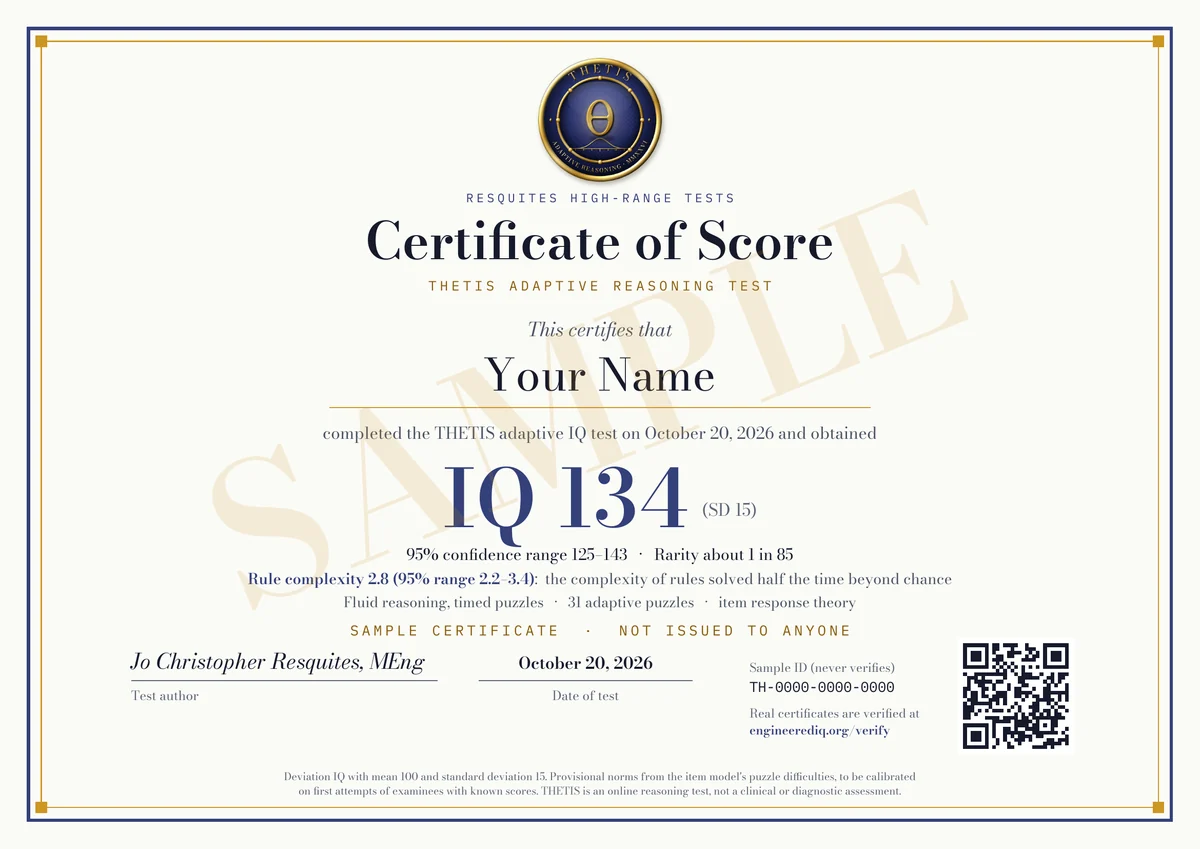
Your score report and certificate
The moment you finish, THETIS shows your report and gives you your certificate as a PDF, ready to download, share or attach to a society application.
- Your IQ on the deviation scale (SD 15), with its 95% confidence range.
- Percentile and rarity: how rare a score this high is in the population.
- Rule complexity: the complexity of the rules you solve half the time beyond chance, a score that depends on no population norm.
- Eight facet scores: a profile of your reasoning across the puzzle families.
- Confidence calibration: how well your confidence matched your answers.
- Estimated equivalents on other scales, for orientation.
- A certificate anyone can check: its ID and QR code open the Verify page, which shows it exactly as issued (you may hide your name there).
What examinees say
Comments from people who took THETIS, quoted with their permission.
What THETIS measures
THETIS measures fluid reasoning through abductive–dynamic reasoning: working out hidden rules from evidence, and noticing when those rules alternate, depend on context or change. Every puzzle uses abstract shapes, cells, cards, lamps, marbles, rings and boats. You need no vocabulary, arithmetic or general knowledge.
Mutable Matrices
Panels that transform
Rows of lattice panels are made by turns, mirrors and slides that may alternate, split by color or follow a cue.
Drifting Strings
Rows that evolve
A ring of cells moves, mirrors, inverts or follows a local law, and the law may change on the way.
The Oracle's Ledger
Rules behind verdicts
From a record of approved and rejected cards, infer the oracle's sorting rule and when it switched.
Translations
One law, three materials
Machines working on lattices, beads and tiles obey one law of combination. Carry it from one material to another.
Levers and Lamps
Causes and interventions
Infer hidden lamp wiring, then predict, reason backward, find the lever used or ask what would have happened.
Turnstiles
Marbles and hidden gates
Marbles roll through gates that flip, flip slowly or stick. Read each gate from the record, then predict, find the stuck gate or ask what would have happened.
Orbits
Motion with a hidden rule
Tokens circle their rings at steady speeds until they meet. Find the meeting rule, sometimes with an invisible token at work, and foresee the rings.
Moorings
What the rules force
Boats and numbered berths, with rule cards that say where each may moor. Deduce where a boat must go, or what must, could or cannot be true.
THETIS is a power test: your IQ comes from how difficult the puzzles you solve are, estimated by item response theory. Each puzzle has a generous clock, and how fast you answer within it never changes your score.
How the puzzles work
Each puzzle shows only a short question, so read these rules before you begin. During the test, the rules for the puzzle in front of you open with one tap.
THETIS described en español and 用中文.
One principle for every puzzle. The answer is the one predicted by the simplest explanation that fits everything shown: the fewest laws, rules or exceptions, then the fewest changes. Every puzzle has been checked by computer to have exactly one such answer. In Moorings every rule is given, and the answer is what must, could or cannot follow from them.
Mutable Matrices panels that transform
Each row is a sequence of lattice panels, and each panel is made from the one before it by hidden laws: quarter turns, mirrors, wrapping slides and color swaps. Laws may alternate, grow step by step, combine, act separately on black and white tokens, follow a cue socket, or change from one row to the next, and the black and the white tokens may each follow a schedule of their own (for example, one color's law grows step by step while the other color's law follows a cue socket). One law may join a turn, mirror or slide with a color swap. A cue socket acts by being filled or empty, whatever the color of its token.
The note above the puzzle says whether one law or several are at work and whether a law may change. Find the panel that replaces the question mark.
Drifting Strings rows that evolve
Each row is a ring of black and white cells: its right end touches its left end. Each row is made from the row above by hidden laws: slides, mirror images, inversion, or a local law in which every cell's next color depends on itself and its two neighbors. Laws may alternate, grow, change once or twice, depend on a feature of the row, or act separately on cells in even and odd places, each set of places with a schedule of its own (for example, one set slides further at every step while the other keeps one law).
The note says whether one law or several are at work and whether a law may change. Find the next row.
The Oracle's Ledger rules behind verdicts
There are four key cards: K1 one black circle, K2 two white triangles, K3 three gray squares, K4 four hatched stars. An oracle approves or rejects each card placed under a key card by a hidden sorting rule: by shape, fill or count, possibly with a fixed offset, always the same key, or an if–then rule. The rule may change, return, or cycle through shape, fill and count. A rule that has changed, or changed back, then stays; a rule that cycles moves on after the same number of approvals each time.
The ledger lists earlier cards in order, where each was placed and the verdict. Say under which key card the oracle will approve the next card.
Translations one law, three materials
Machines combine two inputs into one output, and at any moment every machine obeys the same law of combination: a fixed rule that gives each cell of the output from the same cell of the two inputs. Any such rule can occur, for example keep everything, keep only what is common, let what is common cancel, keep what the first input has and the second lacks, or mark only the cells both inputs leave blank. Machine A works on lattices, B on bead strings and C on tile rows. A machine may record presence with the opposite color; it then does so in both inputs and in its output alike, in every run, and each such machine counts as one exception, added to the number of laws.
The law may change between runs or repeat in a cycle of any length. Once a cycle has been seen twice in full (each run's law read through its machine's colors), it counts: it goes on, and the changes within it are not counted. Until then, a law that changed and changed back stays: after the laws X, Y, X the law stays X, while after X, Y, X, Y the cycle counts and the next law is X. Runs are shown in the order they happened. Give the output of the final run.
Levers and Lamps causes and interventions
A board of lamps changes tick by tick. Each lamp's next state is a fixed hidden function of at most two lamps' current states (copy, opposite, both, either, exactly one, and so on; a lamp may watch itself), the same in every run. A lever can hold one lamp on or off for a whole run. In some puzzles one lamp is hidden from view, but it still takes part.
The simplest wiring is the one with the fewest input wires. The question under each puzzle says what to find: a later board, a starting board, a lever, or what would have happened.
Turnstiles marbles and hidden gates
Marbles roll through a machine one at a time, from an entry at the top into a numbered bucket. Each gate sends a marble left or right, then either flips after every marble, flips only after every second marble that passes it (a slow gate), or never moves (a stuck gate). Gates are drawn without their directions; the record shows where earlier marbles entered and where they came out. A slow gate may already be partway through its count when the record starts.
The note says which kinds of gate can occur. Assume as few exceptions as the record allows: a stuck gate counts one, a slow gate two. When the note says a gate broke, take it as given that one gate which flipped after every marble became stuck for good during the record, and keep the other exceptions as few as possible.
Orbits motion with a hidden rule
Each token moves around its own ring of eight positions (one on each spoke) by a steady number of steps per tick, clockwise or counterclockwise. When a token arrives at the same spoke as another token, the two meet; a token that does not move arrives nowhere, so tokens resting on one spoke do not meet again. If the note says a meeting rule is at work, one fixed hidden rule acts at every meeting: both tokens turn back, or the two exchange speeds and directions, or both rest for one tick. Without that note, tokens never affect each other.
A dashed ring holds an invisible token that moves and meets like the others. Snapshots show the rings at ticks 0, 1, 2 and so on; choose the picture of the asked tick.
Moorings what must follow from the rules
Boats, drawn as shapes, take the numbered berths of a pier: one boat to a berth, and every berth filled. The shape is the boat; all boats have the same color. At the top levels two piers lie side by side: the berths are numbered left to right across both, and the two berths on either side of the gap are not next to each other.
Rule cards say, in pictures, where boats may go (the legend below). Every rule holds and nothing is hidden. An arrangement is any way of mooring the boats that obeys every rule. The question asks which berth a boat must take; which statement must be true (in every arrangement), could be true (in at least one) or cannot be true (in none); or which added rule would leave exactly one arrangement. A card marked Suppose is one more rule for that question only.
Moorings is the newest family. Its puzzles start as trial puzzles, two in each session, which do not count toward your score while their difficulty is calibrated on examinees' answers; a level that has been calibrated counts like every other puzzle.
No charge · untimed · not scored
The practice module: 16 puzzles
Two puzzles from each of the eight families, so the format is never what decides your score. After every answer you see why the right option is right and what to notice, including how to spot a rule that changes. The practice module is required before the scored test, and you can repeat it as often as you like.
Accuracy you can check
Every THETIS puzzle is proven by computer to have exactly one best answer, and every claim below comes with how it was obtained. In October 2026 every key was checked again by separate programs written from the rules alone, without the puzzle generators; the 135 puzzles they could not confirm were retired, and so was every puzzle whose answer could be read off or copied from the puzzle itself: 749 in all. On 20 October 2026 the 829 puzzles whose evidence repeated an entry, such as a card shown twice under the same key card, were withdrawn, the Oracle's Ledger ones replaced by corrected puzzles. Every puzzle added since 15 October 2026 passed the same programs under every reading before it joined the bank.
- 208,718candidate puzzles generated and machine-verified
- 19,345scored puzzles in eight families, each key confirmed twice
- .92projected reliability (general population)
- ±9points: the 95% range reported with each score, IQ 55 to 200
Reliability, precision and the retest correlation of .91 (two sessions with no puzzle in common) are projections from 78,000 simulated sessions of the live adaptive engine on its item bank. The puzzle difficulties come from the item model: a first calibration on examinees with known IQ scores (7 October 2026) is on hold until it can rest on the first attempts of at least 10 such examinees. Norms are provisional. THETIS is an online reasoning test, not a clinical or diagnostic assessment.
Have you taken a professionally given IQ test? A score from a psychologist's test such as the WAIS or the SB5, or another supervised test, helps place the THETIS puzzles on the IQ scale. Volunteers whose score report is checked take their first THETIS session at half the fee. Help norm THETIS.
Take THETIS now
Find a quiet place. Most people finish in 25 to 45 minutes; each puzzle has its own generous clock, and you can take a break between puzzles. Use a computer or tablet if you can, though a phone works too. Have scratch paper ready.
- What THETIS measures
- How it adapts
- How to move through it
What THETIS measures
THETIS measures fluid reasoning: how well you find a hidden rule in material you have never seen, test your idea against the evidence, and update it when the rule changes. It uses only abstract shapes, cells, cards, lamps, marbles, rings and boats.
- No vocabulary, no school arithmetic, no general knowledge.
- A generous clock on each puzzle (3 to 20 minutes, by difficulty). How fast you answer within it never changes your score.
- Every puzzle has exactly one best answer: the one predicted by the simplest explanation that fits everything shown (in Moorings, the one that follows from the rules).
How the adaptive engine works
Every answer updates an estimate of your reasoning level, and the next puzzle is the one that measures best at that level: harder after a right answer, easier after a wrong one. The first five puzzles are of average difficulty.
- Expect to get many puzzles wrong. That is how an adaptive test finds your level, and it is true at every level.
- The test ends when your score is precise enough: usually about 30 puzzles (between 20 and 45).
- Your IQ appears at once, with a margin of error and a certificate anyone can verify.
How to move through the test
Choose an option, say how sure you are if you like, and press Next. Answers are final: there is no Back button.
- Rules above each puzzle opens the rules of that family.
- The clock at the top shows the time left for the puzzle on screen. Tick Take a break after this puzzle to rest: no clock runs until you continue.
- Your progress is saved after every answer. If your connection drops, THETIS reconnects by itself and continues where you stopped; if you close the page, reopen your private link.
- Take the test alone, with scratch paper only. While a puzzle is on screen, THETIS records when and for how long you leave the test window, screenshot keys, copy or print attempts and browser add-ons that insert themselves into the page. Each puzzle carries a faint watermark with your name, certificate ID, puzzle number and time. This integrity record never changes your score.
- Before the test, 16 practice puzzles (two from each family) show you every format, with the reasoning explained after each one.
Already practiced in this browser? Go to registration.
Practice module: 16 puzzles, not scored
Two puzzles from each family. After each answer you see why the right option is right. The scored test opens once you have worked through all sixteen.
Practice complete
You have now seen all eight families and the kinds of change they contain. In the scored test you will not see whether an answer is right, and the puzzles adapt to your level.
Your details
Already paid? Recover my test
Payment
- THETIS adaptive IQ test, one session with certificateUS$19.99
- Name on certificate
Payment is processed by PayPal; you can pay with a PayPal account or a debit or credit card. Your test is ready the moment the payment completes, and you can start at once or later.
Have a code?
Your test is ready,
Begin when you are ready. Each puzzle has its own clock, shown at the top; between puzzles you can take a break.
- “Rules” above each puzzle opens the rules for that kind of puzzle, and how the puzzles work is below.
- Choose an option and press Next (or use the option's key and Enter). Answers are final: there is no going back.
- Each puzzle has its own clock (3 to 20 minutes), kept by our server: it keeps running if you leave the page. To rest, tick “Take a break after this puzzle”; no clock runs during a break.
- Stay on the test page while a puzzle is open. Leaving it, copying and printing are recorded for the author's review; they never change your score.
- After each answer you may say how sure you were. It never changes your IQ; it gives you a confidence-calibration index.
- Your progress is saved after every answer. If your connection drops, THETIS reconnects by itself. If you close the page, return with the link below or with “Recover my test” (your PayPal Transaction ID and email).
- Work alone, with scratch paper only. Please do not copy or share the puzzles.
Camera check (required)
While a puzzle is on screen, this page watches your camera for a phone, another person or an empty seat. The check runs in your own browser: the video never leaves your device. When it sees one of these, it keeps a small still picture for the author's review, deleted after 90 days. It never changes your score, and your certificate's verification page shows that it covered your whole test.
- Sit facing the camera in good light, with your face in view.
- Keep your phone and other devices out of reach, and work alone.
- If the camera stops, the puzzle is covered until it is back, and its clock keeps running.
Welcome back,
You have an active session. Resume?
Loading the next puzzle…
Break
You are on a break
0 puzzles answered. No puzzle is open and no clock is running. Rest your eyes, stretch, have some water.
When you press Continue, the next puzzle opens and its clock starts. You can also close this page and come back later with your private link.
Scoring your test…
Estimating your fluid-reasoning level from every answer you gave.
Your THETIS result
IQ (SD 15)
Overall fluid reasoning · 95% range ·
Your THETIS IQ is a deviation IQ of fluid reasoning (mean 100, SD 15), estimated by item response theory from all of your answers. Your true score most likely lies inside the 95% range.
Confirm your score with a supervised assessment
List your best verified scores in the Resquites Register, and from three tests or more get your Resquites Composite IQ.
A picture of your result to share
Your IQ, its 95% range, the date and your certificate's Verify address, sized for Facebook, Instagram and LinkedIn posts. It is drawn in your browser; nothing is uploaded.
Record fingerprint : the server sealed your answers, their times and what this page recorded when the test ended. The same fingerprint is on your certificate, so the record can never be changed without the change showing.
Eight facets of fluid reasoning
Scaled scores (mean 100, SD 15). Each facet rests on only a few puzzles, so its range is much wider than your overall IQ's; read them as a profile, not as separate scores.
| Facet | Score | 95% range | Right |
|---|
Confidence calibration
The same standing on other scales
Conversions at the same percentile rank. THETIS has not yet been equated with these tests, so these are scale conversions, not predictions of your score on them.
| Test | Scale | Equivalent |
|---|
About this score
Help validate THETIS (optional, about one minute)
Your answers let THETIS be compared with established tests and checked for fairness. They are stored with your result without your name or email, and appear only in de-identified research summaries. Skip any question you like.
Thank you. Your answers are saved with your result.
You agreed to be contacted: please email a scan or photo of the report of your earlier test to jresquites@mensaphilippines.org, with your THETIS certificate number. The author uses it only to check the score, and deletes it once checked.
How was THETIS?
Rules, fee and privacy
Test rules
Take THETIS alone, with scratch paper only (breaks between puzzles are allowed): no other person, AI system, search engine, program or written aid. Each puzzle has its own clock, from 3 to 20 minutes by difficulty, kept by our server; a puzzle not answered in time counts as wrong. Between puzzles you may take a break. Do not copy, record or share the puzzles: each one carries a faint watermark with your name, certificate ID, puzzle number and time. A session belongs to the person named on it, and its certificate states that person's result.
While a puzzle is on screen, THETIS records when and for how long you leave the test window (not where you go), screenshot keys, copy or print attempts and browser add-ons that insert themselves into the page, and its camera check, which every session requires, watches your camera for a phone, another person or an empty seat. With the consistency of your answers and of your answer times, this forms your integrity record, which the author reviews before any society admission; it never changes your score.
Fee and refunds
One session costs US$19.99, paid through PayPal (PayPal account or card). Because the test and its result are delivered at once, a session cannot be refunded after it has started. If a technical fault on our side stops your session, email jresquites
Privacy notice
We collect your name, email, year of birth, country (if you give it), your answers and response times, how often you leave the test window during a puzzle and any copy or print attempts, and your PayPal order and transaction numbers. We use them to run your session, issue and verify your certificate, avoid repeating puzzles you have seen, and calibrate the test's norms from de-identified data. The camera check, which every test requires, runs in your own browser: the video from your camera is analyzed on your device and is never sent or stored. When it sees a phone, another person or an empty seat while a puzzle is on screen, the page sends one small still picture (160 by 120 pixels) with its time, kept for the author's review and deleted 90 days after it was taken; its summary of each puzzle (how long it watched, and when it saw any of these) is kept with your integrity record. The detector's program and model load from public servers (jsDelivr and Google), which see your device's address as any website does. When your test ends, your result, the private link to it and your personal codes are emailed to you (through Resend, an email service). If you leave feedback after your result, it is kept with your certificate ID, and only if you agree may the author quote your comment on this site, with your first name and country. If you volunteer to help norm THETIS, the earlier score you report is kept with your application, and the copy of its report you email is deleted once checked. If you answer the optional questionnaire after your result (earlier test scores, device, first language, education, sex), those answers are stored with your consent alongside your de-identified result and used only in research summaries. If you also tick the box that the author may contact you to confirm an earlier score, the author sees your name and email with your answers and may write to ask for proof of that score (a report or certificate); a confirmed score helps calibrate the puzzles' difficulties and never changes your own THETIS score. How you reached the site (the name of the site or app that linked to it, or the tag in the link you followed, which your browser keeps for 30 days) is recorded with your payment or code, without your name, to count which channels bring examinees; and the site counts, day by day, how many browsers visited, practiced and opened the payment screen, without recording who. Anyone who has your certificate ID can see the name, score and date on the verification page. Payments are handled by PayPal and the site is hosted by Netlify; we never see your card details. Data are kept while your certificate can be verified. To see, correct or delete your data, email jresquites
THETIS questions
Is THETIS a real IQ test?
THETIS reports a deviation IQ (mean 100, SD 15) estimated by item response theory, the method behind modern adaptive tests. Its puzzle difficulties come from its item model and will be calibrated on first attempts of examinees whose IQ is known from established tests; until then its norms are provisional. It is an online reasoning test, not a clinical or diagnostic assessment by a psychologist: for an official score, take a supervised test.
Can I use my THETIS score to join Mensa?
No. Mensa admits members who score at or above the 98th percentile (about IQ 131 on the SD 15 scale THETIS uses) on an approved, properly supervised intelligence test, and online tests cannot be used for admission. If your THETIS score is 120 or higher (Superior or above in the Stanford-Binet Fifth Edition classification), take the supervised admission test of your national Mensa, or consult a licensed psychologist for an individually administered intelligence test such as the Stanford-Binet Intelligence Scales, Fifth Edition (SB5) or the Wechsler Adult Intelligence Scale, Fifth Edition (WAIS-5), to obtain an official score. A THETIS certificate counts for all five Resquites societies.
How high can a THETIS score go?
THETIS reports scores from about IQ 40 up to its ceiling, IQ 230+. It measures precisely, with a margin of about 9 IQ points either way, from about IQ 55 to 200, and the margin widens outside that range. From IQ 180 up, the test climbs one level of 10 points at a time (180–189, 190–199, and so on): the next level opens only once you have solved at least three puzzles of the level below, from at least two different families, with at least two in three of its puzzles right, and your score cannot pass the top of the highest level you opened (since 3 November 2026). Above IQ 230 a score can no longer be measured as precisely, so a performance beyond it is reported as IQ 230+ rather than as a single figure. (Certificates issued before 20 October 2026 show the earlier ceiling, IQ 220+.) Above about IQ 190 a score is a position on the THETIS scale rather than a population rarity.
What is the rule complexity on my report?
Next to your IQ, THETIS gives your rule complexity: the complexity of the rules you solve half the time beyond chance. Every THETIS puzzle is rated by its rules (how many laws, how often they change, what is hidden, how much must be held in mind), and that rating sets its difficulty; your rule complexity reads your result on the same scale. Your IQ says how rare your result is among people, which needs norms; your rule complexity says what you solved, so it depends on no norm and keeps its meaning at the very top of the scale. It is the same estimate in other units, with the same 95% range.
Is THETIS timed?
Yes, generously. Each puzzle has its own clock, from 3 minutes for the easiest to 20 minutes for the hardest (eight times the time it is expected to take), kept by our server and shown at the top of the puzzle; a puzzle not answered in time counts as wrong. Your IQ still comes only from how difficult the puzzles you solve are: there is no speed bonus. Between puzzles you can take a break: tick “Take a break after this puzzle”, and no clock runs until you continue. The clocks keep the test the same for everyone and make outside help harder.
What happens if my connection drops or I close the page?
Nothing is lost. Every answer is saved on the server the moment you give it, and an answer that has not reached the server yet is kept in your browser and sent again automatically. THETIS shows “Reconnecting…” and continues by itself when the connection returns. If you close the page, open your private test link again (or use “Recover my test”) and press Resume.
Can I take THETIS more than once?
Yes. Each session is a new purchase with new puzzles: THETIS never shows you a puzzle you have already seen, or a close variant of one. Your score is shown at once; from your second session, the certificate is issued by the test author, who sends you the one you need, as a rule that of your best result. Expect a small practice effect on a retake, as with any test. For admission to the Resquites societies, your best THETIS certificate counts.
Can I use a phone?
Yes. The puzzles resize to fit, but a larger screen makes the bigger puzzles easier to read. Keep a steady connection; if it drops, reopen your test link and continue.